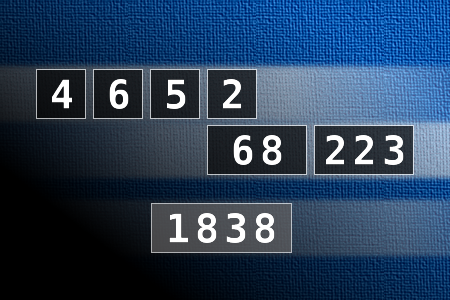

Calculate the number 1838
[6844] Calculate the number 1838 - NUMBERMANIA: Calculate the number 1838 using numbers [4, 6, 5, 2, 68, 223] and basic arithmetic operations (+, -, *, /). Each of the numbers can be used only once. - #brainteasers #math #numbermania - Correct Answers: 11 - The first user who solved this task is Nasrin 24 T
BRAIN TEASERS
enter your answer and press button OK

Calculate the number 1838

NUMBERMANIA: Calculate the number 1838 using numbers [4, 6, 5, 2, 68, 223] and basic arithmetic operations (+, -, *, /). Each of the numbers can be used only once.
Correct answers: 11
The first user who solved this task is Nasrin 24 T.
#brainteasers #math #numbermania
Register with your Google Account and start collecting points.
Check your ranking on list.

The Shower

Ray shows up at the bar all out of breath so Dewey asks him what the hell is wrong with you?
So Ray says "Ive been running from the cops but I finally lost them"
Dewey then asked "what the hell did you do?"
Ray replied " I was pissing in the shower and the cops showed up to arrest me!"
"Thats not against the law" said Dewey,
"Thats what I thought," said Ray.
"But those guys at Home Depot sure must of thought it was"

Jokes of the day - Daily updated jokes. New jokes every day.
Follow Brain Teasers on social networks

Brain Teasers

puzzles, riddles, mathematical problems, mastermind, cinemania...

Hattie Elizabeth Alexander

Died 24 Jun 1968 at age 67 (born 5 Apr 1901).American pediatrician and microbiologist whose groundbreaking work on influenzal meningitis significantly reduced infant death rates and advanced the field of microbiological genetics. She made a major contribution in her third published paper (1939), devising an anti-influenzal rabbit serum against H. influenzae type b, the causative organism of a then almost uniformly fatal meningitis in infants and children. Her antiserum reduced the mortality rate to 20 percent. When the advent of antibiotics made the antiserum obsolete, she quickly mastered their use against all the bacterial meningitides. Late in her career--the 1950s and 60s--she became a pioneer in microbial genetics. Over 30 years she published some 70 papers.
This site uses cookies to store information on your computer. Some are essential to help the site properly. Others give us insight into how the site is used and help us to optimize the user experience. See our privacy policy.