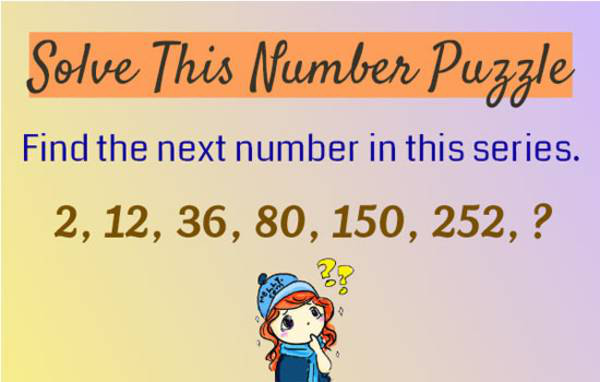
Solve This Number Puzzle
[1999] Solve This Number Puzzle - Find the next number in this series (2, 12, 36, 80, 150, 252, ?). - #brainteasers #math #riddles - Correct Answers: 84 - The first user who solved this task is On On Lunarbasil
BRAIN TEASERS
enter your answer and press button OK

Solve This Number Puzzle

Find the next number in this series (2, 12, 36, 80, 150, 252, ?).
Correct answers: 84
The first user who solved this task is On On Lunarbasil.
#brainteasers #math #riddles
Register with your Google Account and start collecting points.
Check your ranking on list.

A middle aged Irish woman went...

A middle aged Irish woman went to her doctor to ask advice in reviving her husband's libido.
"What about trying Viagra?" asked the doctor.
"Not a chance," she said. "He won't even take an aspirin."
"Not a problem," replied the doctor. "Drop the Viagra tablet into his coffee. He won't even taste it... Give it a try and call me in a week to let me know how things went."
When she called the doctor he asked how it went and she exclaimed, "Oh, faith, bejaysus and begorrah! It was horrid! Just terrible, doctor!'
"Really? What happened?" asked the doctor.
"Well, I did as you said and slipped it in his coffee and after just a few sips he jumped straight up, with a twinkle in his eye and with his pants a-bulging fiercely!
With one swoop of his arm, he sent the cups and tablecloth flying, ripped me clothes to tatters and took me then and there passionately on the tabletop! It was a nightmare, I tell you, an absolute nightmare!"
"Do you mean the sex your husband provided wasn't good?"
"Bejaysus, it was the best sex I've had in 25 years! But sure as I'm sitting here, I'll never be able to show me face in Starbucks again!"
Jokes of the day - Daily updated jokes. New jokes every day.
Follow Brain Teasers on social networks

Brain Teasers

puzzles, riddles, mathematical problems, mastermind, cinemania...

Polykarp Kusch

Born 26 Jan 1911; died 20 Mar 1993 at age 82. German-American physicist who shared the Nobel Prize for Physics in 1955 for his accurate determination that the magnetic moment of the electron is greater than its theoretical value. This he deduced from researching the hyperfine structure of the energy levels in certain elements, and in 1947 found a discrepancy of about 0.1% between the observed value and that predicted by theory. Although minute, this anomaly was of great significance and led to revised theories about the interactions of electrons with electromagnetic radiation, now known as quantum electrodynamics. (He shared the prize with Willis E. Lamb, Jr. who performed independent but related experiments at Columbia University on the hyperfine structure of the hydrogen atom.)
This site uses cookies to store information on your computer. Some are essential to help the site properly. Others give us insight into how the site is used and help us to optimize the user experience. See our privacy policy.