What a winning combination?
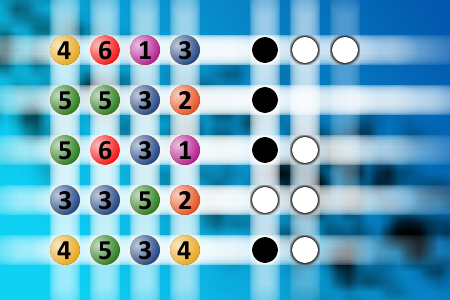
[5620] What a winning combination? - The computer chose a secret code (sequence of 4 digits from 1 to 6). Your goal is to find that code. Black circles indicate the number of hits on the right spot. White circles indicate the number of hits on the wrong spot. - #brainteasers #mastermind - Correct Answers: 33 - The first user who solved this task is Djordje Timotijevic
BRAIN TEASERS
enter your answer and press button OK

What a winning combination?

The computer chose a secret code (sequence of 4 digits from 1 to 6). Your goal is to find that code. Black circles indicate the number of hits on the right spot. White circles indicate the number of hits on the wrong spot.
Correct answers: 33
The first user who solved this task is Djordje Timotijevic.
#brainteasers #mastermind
Register with your Google Account and start collecting points.
Check your ranking on list.

Ex-Girlfriend

A man and his wife are dining at a table in a plush restaurant, and the husband keeps staring at a drunken lady swigging her drink as she sits alone at a nearby table.
The wife asks, "Do you know her?"
"Yes," sighs the husband, "she's my ex-girlfriend. I understand she took to drinking right after we split up seven years ago, and I hear she hasn't been sober since."
"My God!" says the wife. "Who would think a person could go on celebrating that long?"   

Jokes of the day - Daily updated jokes. New jokes every day.
Follow Brain Teasers on social networks

Brain Teasers

puzzles, riddles, mathematical problems, mastermind, cinemania...

Wilhelm Wien

Born 13 Jan 1864; died 30 Aug 1928 at age 64. German physicist who received the Nobel Prize for Physics in 1911 for his displacement law concerning the radiation emitted by the perfectly efficient blackbody (a surface that absorbs all radiant energy falling on it). While studying streams of ionized gas Wien, in 1898, identified a positive particle equal in mass to the hydrogen atom. Wien, with this work, laid the foundation of mass spectroscopy. J. J. Thomson refined Wien's apparatus and conducted further experiments in 1913 then, after work by Ernest Rutherford in 1919, Wien's particle was accepted and named the proton. Wien also made important contributions to the study of cathode rays, X-rays and canal rays.
This site uses cookies to store information on your computer. Some are essential to help the site properly. Others give us insight into how the site is used and help us to optimize the user experience. See our privacy policy.