What a winning combination?
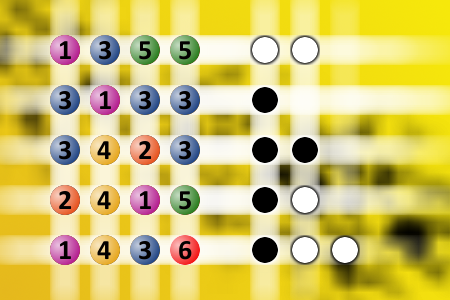
[5681] What a winning combination? - The computer chose a secret code (sequence of 4 digits from 1 to 6). Your goal is to find that code. Black circles indicate the number of hits on the right spot. White circles indicate the number of hits on the wrong spot. - #brainteasers #mastermind - Correct Answers: 30 - The first user who solved this task is Nílton Corrêa De Sousa
BRAIN TEASERS
enter your answer and press button OK

What a winning combination?

The computer chose a secret code (sequence of 4 digits from 1 to 6). Your goal is to find that code. Black circles indicate the number of hits on the right spot. White circles indicate the number of hits on the wrong spot.
Correct answers: 30
The first user who solved this task is Nílton Corrêa De Sousa.
#brainteasers #mastermind
Register with your Google Account and start collecting points.
Check your ranking on list.

Punctuality

A company owner was asked a question, 'How do you motivate your employees to be so punctual?'
He smiled & replied, 'It's simple. I have 30 employees and 29 free parking spaces.
...... One is paid parking.'

Jokes of the day - Daily updated jokes. New jokes every day.
Follow Brain Teasers on social networks

Brain Teasers

puzzles, riddles, mathematical problems, mastermind, cinemania...

Tuzo Wilson

Died 15 Apr 1993 at age 84 (born 24 Oct 1908). John Tuzo Wilson was a Canadian geologist and geophysicistwho determinedthe underlying structure of faults, continents across the globe. From the early 1960s, Wilson revolutionized the emerging field of plate tectonics. He coined the word“plate” for the rigid subdivisions of the Earth's crust of both land and ocean beds. By 1963, he identified some of the earliest evidence supporting the sea-floor spreading hypothesis of Harry H. Hess. Wilson showed the relationship that islands were older for those further away from mid-ocean ridge. One of his important new ideas (1965) was for transform faults, where plate boundaries meet in a series of of offsets, and the plates slide alongside past each other without any creation or destruction of the crust. It is a conservative plate boundary beecause neither plate slides under the other.«
This site uses cookies to store information on your computer. Some are essential to help the site properly. Others give us insight into how the site is used and help us to optimize the user experience. See our privacy policy.