What a winning combination?
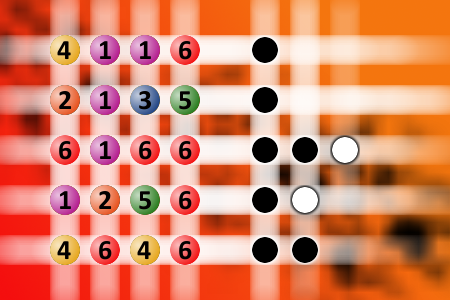
[5895] What a winning combination? - The computer chose a secret code (sequence of 4 digits from 1 to 6). Your goal is to find that code. Black circles indicate the number of hits on the right spot. White circles indicate the number of hits on the wrong spot. - #brainteasers #mastermind - Correct Answers: 22 - The first user who solved this task is Nílton Corrêa De Sousa
BRAIN TEASERS
enter your answer and press button OK

What a winning combination?

The computer chose a secret code (sequence of 4 digits from 1 to 6). Your goal is to find that code. Black circles indicate the number of hits on the right spot. White circles indicate the number of hits on the wrong spot.
Correct answers: 22
The first user who solved this task is Nílton Corrêa De Sousa.
#brainteasers #mastermind
Register with your Google Account and start collecting points.
Check your ranking on list.

A man and his wife were sittin...

A man and his wife were sitting in the living room discussing a “Living Will”
"Just so you know, I never want to live in a vegetative state, dependent on some machine and fluids from a bottle. If that ever happens, just pull the plug."
His wife got up, unplugged the TV and threw out all the beer.
Jokes of the day - Daily updated jokes. New jokes every day.
Follow Brain Teasers on social networks

Brain Teasers

puzzles, riddles, mathematical problems, mastermind, cinemania...

Atom split

In 1932, the atom was split by a proton beam on a lithium target. Two physicists, Englishman Sir John Douglas Cockcroft and Irishman Errnest Walton had developed the first nuclear particle accelerator (the Cockcroft-Walton generator for which they shared 1951 Nobel Prize for Physics. The accelerator was built in a disused room in the Cavendish Laboratory. With this equipment, Walton succeeded in being the first to split the atom (its nucleus). When a proton from the beam supplied by the accelerator struck a lithium nucleus, their unstable combination disintegrated into two alpha particles (helim nuclei). Walton observed the scintillations characteristic of alpha particles on a zinc sulphide screen.«
This site uses cookies to store information on your computer. Some are essential to help the site properly. Others give us insight into how the site is used and help us to optimize the user experience. See our privacy policy.