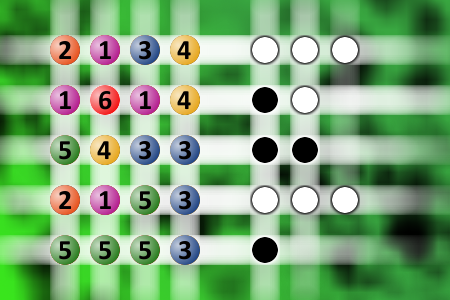
What a winning combination?
[5995] What a winning combination? - The computer chose a secret code (sequence of 4 digits from 1 to 6). Your goal is to find that code. Black circles indicate the number of hits on the right spot. White circles indicate the number of hits on the wrong spot. - #brainteasers #mastermind - Correct Answers: 24 - The first user who solved this task is Nasrin 24 T
BRAIN TEASERS
enter your answer and press button OK

What a winning combination?

The computer chose a secret code (sequence of 4 digits from 1 to 6). Your goal is to find that code. Black circles indicate the number of hits on the right spot. White circles indicate the number of hits on the wrong spot.
Correct answers: 24
The first user who solved this task is Nasrin 24 T.
#brainteasers #mastermind
Register with your Google Account and start collecting points.
Check your ranking on list.

Now What? (world's funniest joke)

Two hunters are out in the woods when one of them collapses. He doesn't seem to be breathing and his eyes are glazed. The other guy whips out his phone and calls the emergency services. .

He gasps, "My friend is dead! What can I do?". .

The operator says "Calm down. I can help. First, let's make sure he's dead." .

There is a silence, then a shot is heard. .

Back on the phone, the guy says "OK, now what?" .

This is The "world's funniest joke", as by the THE SCIENTIFIC SEARCH FOR THE WORLD’S FUNNIEST JOKE by Richard Wiseman, of the University of Hertfordshire in 2002

The Winning joke, which was later found is based on a 1951 Goon Show sketch by Spike Milligan

Photo by Rhett Noonan on Unsplash

Happy International Joke Day July the first!

Jokes of the day - Daily updated jokes. New jokes every day.
Follow Brain Teasers on social networks

Brain Teasers

puzzles, riddles, mathematical problems, mastermind, cinemania...

Uranus moon

In 1787, William Herschel, a German astronomer, discovered the first two moons of Uranus, six years after he had discovered the planet, on 13 Mar 1781. Titania's diameter is 998.2 miles (1610 km) and its distance from Uranus is 271,104 miles (436,300 km). Oberon, the outermost of the major moons of Uranus, has a mean diameter of 1523 km and a mean distance from Uranus of 583,500 km. These names were suggested by Herschel's son John Herschel in 1852 at the request of William Lassell, who had discovered two more moons of Uranus the year before which became known as Ariel and Umbriel.«
This site uses cookies to store information on your computer. Some are essential to help the site properly. Others give us insight into how the site is used and help us to optimize the user experience. See our privacy policy.