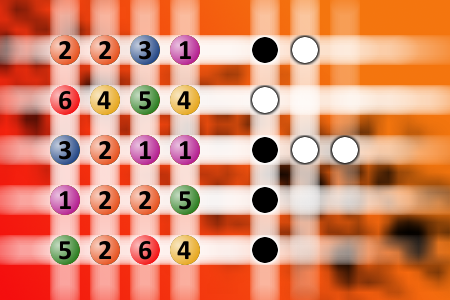
What a winning combination?
[6035] What a winning combination? - The computer chose a secret code (sequence of 4 digits from 1 to 6). Your goal is to find that code. Black circles indicate the number of hits on the right spot. White circles indicate the number of hits on the wrong spot. - #brainteasers #mastermind - Correct Answers: 22 - The first user who solved this task is Nasrin 24 T
BRAIN TEASERS
enter your answer and press button OK

What a winning combination?

The computer chose a secret code (sequence of 4 digits from 1 to 6). Your goal is to find that code. Black circles indicate the number of hits on the right spot. White circles indicate the number of hits on the wrong spot.
Correct answers: 22
The first user who solved this task is Nasrin 24 T.
#brainteasers #mastermind
Register with your Google Account and start collecting points.
Check your ranking on list.

A woman asked an Army General when was the last time...

A woman asked an Army General when was the last time he had made love to a woman.

The general replied “1956, ma’am.” The woman, in disbelief, said “1956?! That long? Come with me and let me make your night better.” The woman and general went back to her apartment and made passionate love for over an hour. Afterwards, the woman cuddled up to the general and said “Well, you sure haven’t forgotten anything since 1956...” The general looked at her, confused, and replied “I sure hope not, it’s only 2130 now.”

Jokes of the day - Daily updated jokes. New jokes every day.
Follow Brain Teasers on social networks

Brain Teasers

puzzles, riddles, mathematical problems, mastermind, cinemania...

Saturn's rings

In 1895, a spectrogram made by American astronomer James Keeler proved that the rings of Saturn were indeed composed of meteoric particles, as predicted by James Maxwell. If the rings were solid, observations would show uniform rotation. However, Keeler's spectrogram of light reflected from Saturn's rings showed a Doppler shift indicating a variation in radial velocity. Thus, particles in the inner part of a ring, closer to Saturn, move at a different rotational speed from those in more distance parts of a ring, as predicted by Kepler's 3rd law. Keeler publishedA Spectroscopic Proof of the Meteoric Constitution of Saturn's Rings in the May 1895 issue of Astrophysical Journal, vol. 1, p.416, the journal he co-founded with George E. Hale.«[Image: artist's illustration of Saturn's rings]
This site uses cookies to store information on your computer. Some are essential to help the site properly. Others give us insight into how the site is used and help us to optimize the user experience. See our privacy policy.