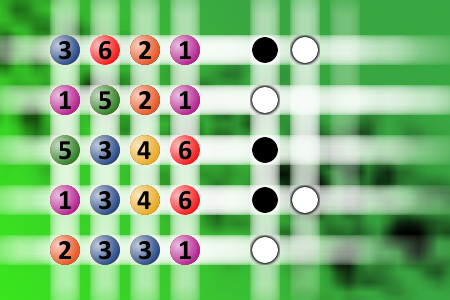
What a winning combination?
The computer chose a secret code (sequence of 4 digits from 1 to 6). Your goal is to find that code. Black circles indicate the number of hits on the right spot. White circles indicate the number of hits on the wrong spot.Correct answers: 18
The first user who solved this task is Nílton Corrêa de Sousa.
#brainteasers #mastermind

Gary and Martin were standing...
Gary and Martin were standing at the urinals in a public lavatory, when Gary glanced over and noticed that Martin's penis was twisted like a corkscrew.
"Wow," Gary said. "I've never seen one like that before."
"Like what?" Martin said.
"All twisted like a pig's tail," Gary said.
"Well, what's yours like?" Martin said.
"Straight, like normal," Gary said.
"I thought mine was normal until I saw yours," Martin said.
Gary finished what he was doing and started to give his old boy a shakedown prior to putting it back in his pants.
"What did you do that for?" Martin said.
"Shaking off the excess drops," Gary said. "Like normal."
"Shoot!" Martin said. "And all these years I've been wringing it."
"Wow," Gary said. "I've never seen one like that before."
"Like what?" Martin said.
"All twisted like a pig's tail," Gary said.
"Well, what's yours like?" Martin said.
"Straight, like normal," Gary said.
"I thought mine was normal until I saw yours," Martin said.
Gary finished what he was doing and started to give his old boy a shakedown prior to putting it back in his pants.
"What did you do that for?" Martin said.
"Shaking off the excess drops," Gary said. "Like normal."
"Shoot!" Martin said. "And all these years I've been wringing it."