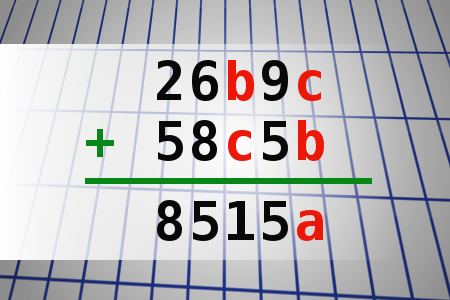
Find number abc
[6053] Find number abc - If 26b9c + 58c5b = 8515a find number abc. Multiple solutions may exist. - #brainteasers #math - Correct Answers: 37 - The first user who solved this task is Nasrin 24 T
BRAIN TEASERS
enter your answer and press button OK

Find number abc

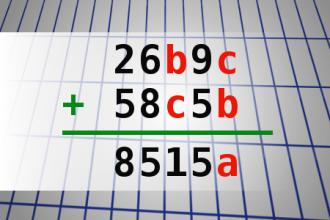
If 26b9c + 58c5b = 8515a find number abc. Multiple solutions may exist.
Correct answers: 37
The first user who solved this task is Nasrin 24 T.
#brainteasers #math
Register with your Google Account and start collecting points.
Check your ranking on list.

The Worst Age

"Sixty is the worst age to be," said the 60-year-old.
"You always feel like you have to pee. And most of the time, you stand at the toilet and nothing comes out!"
"Ah, that's nothin'," said the 70-year-old. "When you're seventy, you can't even crap anymore. You take laxatives, then you sit on the toilet all day and nothin' comes out!"
"Actually," said the 80-year-old, "80 is the worst age of all!"
"Do you have trouble peeing too?" asked the 60-year-old.
"No, not really. I pee every morning at 6:00. I pee like a racehorse on a flat rock; no problem at all."
"Do you have trouble crapping?" asked the 70-year-old.
"No, I crap every morning at 6:30."
With great exasperation, the 60-year-old said, "Let me get this straight. You pee every morning at 6:00 and crap every morning at 6:30.
So what's so tough about being 80?"

"I don't wake up until 7:00!"

Jokes of the day - Daily updated jokes. New jokes every day.
Follow Brain Teasers on social networks

Brain Teasers

puzzles, riddles, mathematical problems, mastermind, cinemania...

John B. Watson

Born 9 Jan 1878; died 25 Sep 1958 at age 80. John Broadus Watson was an American psychologist whose ideas initiated behaviorism as a branch of psychology. Inspired by the recent work of Ivan Pavlov, he studied the biology, physiology, and behavior of animals. Watson viewed animals as extremely complex machines that responded to situations according to their “wiring,”or nerve pathways that were conditioned by experience. When he continued with studies of the behavior of children, his conclusion was that humans, while more complicated than animals, operated on the same principles. Watson's behaviourism dominated psychology in the U.S. in the 1920s and '30s.
This site uses cookies to store information on your computer. Some are essential to help the site properly. Others give us insight into how the site is used and help us to optimize the user experience. See our privacy policy.