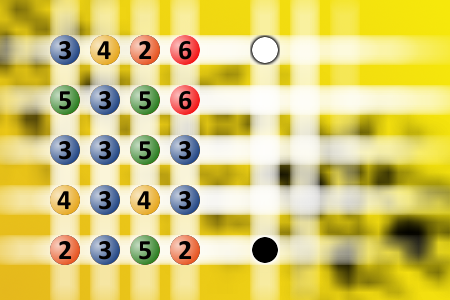
What a winning combination?
[6779] What a winning combination? - The computer chose a secret code (sequence of 4 digits from 1 to 6). Your goal is to find that code. Black circles indicate the number of hits on the right spot. White circles indicate the number of hits on the wrong spot. - #brainteasers #mastermind - Correct Answers: 32 - The first user who solved this task is Nasrin 24 T
BRAIN TEASERS
enter your answer and press button OK

What a winning combination?

The computer chose a secret code (sequence of 4 digits from 1 to 6). Your goal is to find that code. Black circles indicate the number of hits on the right spot. White circles indicate the number of hits on the wrong spot.
Correct answers: 32
The first user who solved this task is Nasrin 24 T.
#brainteasers #mastermind
Register with your Google Account and start collecting points.
Check your ranking on list.

International Day for Monuments and Sites/World Heritage Day jokes

Today is International Day for Monuments and Sites (World Heritage Day)! Find a joke about it!

Why the great pyramids are in Egypt?
Because they were too heavy to carry of to the British museum.

Why was Cleopatra angry?
She was on her pyramid.

I was offered a job building Egyptian tombs
Turned out to be a pyramid scheme

I'm surprised the tower of Pisa hasn't fallen over during the pandemic
Without all those tourists helping hold it up.

Two Americans are visiting Rome Colosseum
"Look at it. How huge and majestic it is."
"Just imagine how great it'll be when they finish building it."

Jokes of the day - Daily updated jokes. New jokes every day.
Follow Brain Teasers on social networks

Brain Teasers

puzzles, riddles, mathematical problems, mastermind, cinemania...

Georges Friedel

Died 11 Dec 1933 at age 68 (born 19 Jul 1865).French crystallographer who formulated basic laws concerning the external morphology and internal structure of crystals. He was the son of Charles Friedel (1832-99), French mineralogist and organic chemist. He recognized, in 1892, that liquid crystals had three types of organisation (mesophases). In 1893, he became professor at the National School of the Mines in Saint-Etienne. After WW I, he moved to the University of Strasbourg. Illness caused his premature retirement in 1930.
This site uses cookies to store information on your computer. Some are essential to help the site properly. Others give us insight into how the site is used and help us to optimize the user experience. See our privacy policy.