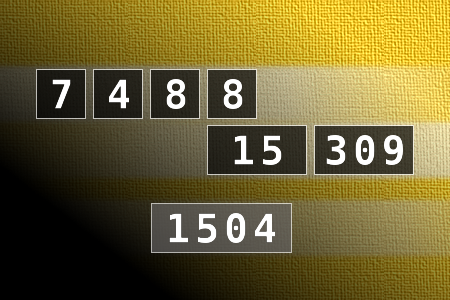

Calculate the number 1504
[6778] Calculate the number 1504 - NUMBERMANIA: Calculate the number 1504 using numbers [7, 4, 8, 8, 15, 309] and basic arithmetic operations (+, -, *, /). Each of the numbers can be used only once. - #brainteasers #math #numbermania - Correct Answers: 10 - The first user who solved this task is Nasrin 24 T
BRAIN TEASERS
enter your answer and press button OK

Calculate the number 1504

NUMBERMANIA: Calculate the number 1504 using numbers [7, 4, 8, 8, 15, 309] and basic arithmetic operations (+, -, *, /). Each of the numbers can be used only once.
Correct answers: 10
The first user who solved this task is Nasrin 24 T.
#brainteasers #math #numbermania
Register with your Google Account and start collecting points.
Check your ranking on list.

Worries While Flying

Two statisticians were travelling in an airplane from LA to New York. About an hour into the flight, the pilot announced that they had lost an engine, but don't worry, there are three left.
However, instead of 5 hours it would take 7 hours to get to New York. A little later, he announced that a second engine failed, and they still had two left, but it would take 10 hours to get to New York.
Somewhat later, the pilot again came on the intercom and announced that a third engine had died. Never fear, he announced, because the plane could fly on a single engine.
However, it would now take 18 hours to get to new York. At this point, one statistician turned to the other and said, "Gee, I hope we don't lose that last engine, or we'll be up here forever!"
Jokes of the day - Daily updated jokes. New jokes every day.
Follow Brain Teasers on social networks

Brain Teasers

puzzles, riddles, mathematical problems, mastermind, cinemania...

Abraham De Moivre

Born c. 26 May 1667; died 27 Nov 1754 . French mathematician who was a pioneer in the development of analytic trigonometry and in the theory of probability. He published The Doctrine of Chance in 1718. The definition of statistical independence appears in this book together with many problems with dice and other games. He also investigated mortality statistics and the foundation of the theory of annuities. He died in poverty, and correctly predicted the day of his own death. He found that he was sleeping 15 minutes longer each night and from this the arithmetic progression, calculated that he would die on the day that he slept for 24 hours.
This site uses cookies to store information on your computer. Some are essential to help the site properly. Others give us insight into how the site is used and help us to optimize the user experience. See our privacy policy.