What a winning combination?
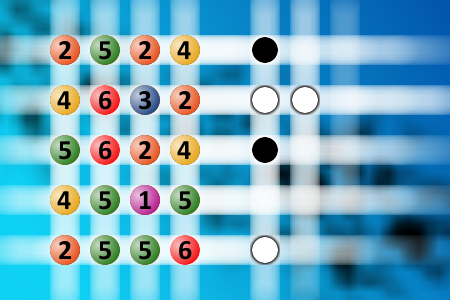
[6800] What a winning combination? - The computer chose a secret code (sequence of 4 digits from 1 to 6). Your goal is to find that code. Black circles indicate the number of hits on the right spot. White circles indicate the number of hits on the wrong spot. - #brainteasers #mastermind - Correct Answers: 28 - The first user who solved this task is Nasrin 24 T
BRAIN TEASERS
enter your answer and press button OK

What a winning combination?

The computer chose a secret code (sequence of 4 digits from 1 to 6). Your goal is to find that code. Black circles indicate the number of hits on the right spot. White circles indicate the number of hits on the wrong spot.
Correct answers: 28
The first user who solved this task is Nasrin 24 T.
#brainteasers #mastermind
Register with your Google Account and start collecting points.
Check your ranking on list.

Wish granted???

A couple had been married for 35 years, and the pair was also celebrating their 60th birthdays. During the celebration, a fairy godmother appeared and said that because they had been such a loving couple all those years, she would give them each one wish.

The wife said she wanted to travel around the world. The fairy godmother waved her magic wand and BOOM! The wife had the tickets in her hand.

Then it was the husband's turn. He paused for a moment, then said boldly, "Well, I'd like to have a wife 30 years younger than I." The fairy godmother picked up her wand and BOOM! He was now 90.

Jokes of the day - Daily updated jokes. New jokes every day.
Follow Brain Teasers on social networks

Brain Teasers

puzzles, riddles, mathematical problems, mastermind, cinemania...

Willard Frank Libby

Born 17 Dec 1908; died 8 Sep 1980 at age 71. American chemist whose technique of carbon-14 (or radiocarbon) dating provided an extremely valuable tool for archaeologists, anthropologists, and earth scientists. For this development he was honoured with the Nobel Prize for Chemistry in 1960. Libby is a specialist in radiochemistry, particularly hot atom chemistry, tracer techniques, and isotope tracer work. He became well-known at Chicago University also for his work with natural tritium, and its use in hydrology and geophysics. On 18 May 1952, he determined that the age of Stonehenge was 1848 BC, based on analysis of radioisotopes in charcoal.
This site uses cookies to store information on your computer. Some are essential to help the site properly. Others give us insight into how the site is used and help us to optimize the user experience. See our privacy policy.