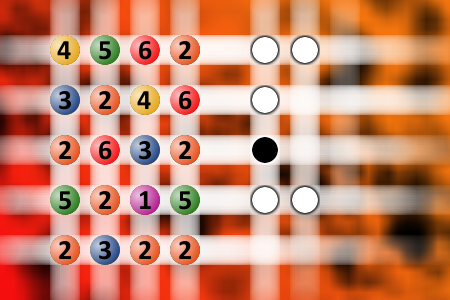

What a winning combination?
[6933] What a winning combination? - The computer chose a secret code (sequence of 4 digits from 1 to 6). Your goal is to find that code. Black circles indicate the number of hits on the right spot. White circles indicate the number of hits on the wrong spot. - #brainteasers #mastermind - Correct Answers: 21 - The first user who solved this task is Nasrin 24 T
BRAIN TEASERS
enter your answer and press button OK

What a winning combination?

The computer chose a secret code (sequence of 4 digits from 1 to 6). Your goal is to find that code. Black circles indicate the number of hits on the right spot. White circles indicate the number of hits on the wrong spot.
Correct answers: 21
The first user who solved this task is Nasrin 24 T.
#brainteasers #mastermind

Register with your Google Account and start collecting points.
Check your ranking on list.

Gabriel Iglesias: The Only Big Friend Argument

When you have nothing but big friends, you never get into arguments -- except one. And that is, who is the biggest? Ill let you know right now, theres only one way to settle this. We all get in a bus and we go to Disney and we get on a roller coaster -- whoever gets the least amount of clicks on the safety bar is the big one.
Jokes of the day - Daily updated jokes. New jokes every day.
Follow Brain Teasers on social networks

Brain Teasers

puzzles, riddles, mathematical problems, mastermind, cinemania...

Raymond Arthur Lyttleton

Died 16 May 1995 at age 84 (born 7 May 1911).English mathematician and theoretical astronomer who researched stellar evolution and composition. In 1939, with Fred Hoyle, he demonstrated the large scale existence of interstellar hydrogen, refuting the existing belief of that space was devoid of interstellar gas. Together, in the early 1940's, they applied nuclear physics to explain how energy is generated by stars. In his own mongraph (1953) Lyttleton described stability of rotating liquid masses, which he extended later to explain that the Earth had a liquid core resulting from a phase change associated with a combination of intense pressure and temperature. With Hermann Bondi, in 1959, he proposed the electrostatic theory of the expanding universe. He authored various astronomy books.
This site uses cookies to store information on your computer. Some are essential to help the site properly. Others give us insight into how the site is used and help us to optimize the user experience. See our privacy policy.