What a winning combination?
[7054] What a winning combination? - The computer chose a secret code (sequence of 4 digits from 1 to 6). Your goal is to find that code. Black circles indicate the number of hits on the right spot. White circles indicate the number of hits on the wrong spot. - #brainteasers #mastermind - Correct Answers: 16 - The first user who solved this task is Nasrin 24 T
BRAIN TEASERS
enter your answer and press button OK

What a winning combination?

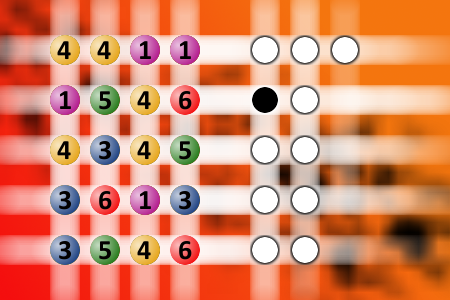
The computer chose a secret code (sequence of 4 digits from 1 to 6). Your goal is to find that code. Black circles indicate the number of hits on the right spot. White circles indicate the number of hits on the wrong spot.
Correct answers: 16
The first user who solved this task is Nasrin 24 T.
#brainteasers #mastermind
Register with your Google Account and start collecting points.
Check your ranking on list.

While going out for a ride wit...

While going out for a ride with his young daughter, a doctor notices the little girl playing with his stethoscope.
He becomes excited, thinking "My daughter is going to follow in my footsteps!"
The girl speaks into the stethoscope like a microphone, "Welcome to Burger King, may I take your order please?"
Jokes of the day - Daily updated jokes. New jokes every day.
Follow Brain Teasers on social networks

Brain Teasers

puzzles, riddles, mathematical problems, mastermind, cinemania...

Life-form patent argued

In 1980, arguments were heard by the U.S. Supreme Court concerning whether a patent could be issued for a genetically-engineered bacterium in the case of Diamond vs. Chakrabarty. On 16 Jun 1980, in a landmark decision, the judges held five to four that the Patent Office should recognize "any" new and useful "manufacture" or "composition of matter," and that the fact that micro-organisms are alive was without legal significance in the related patent law. Microbiologist, Ananda Chakrabarty had appealed the rejection of his 1972 patent application for a human-made, genetically engineered bacterium capable of breaking down crude oil, which no naturally occurring bacteria could do. The patent was eventually issued 31 Mar 1981.«[Image: the patented Burkholderia cepacia bacterium; inset: Chakrabarty]
This site uses cookies to store information on your computer. Some are essential to help the site properly. Others give us insight into how the site is used and help us to optimize the user experience. See our privacy policy.