
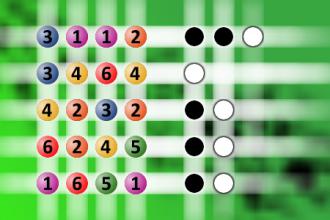
What a winning combination?
[7121] What a winning combination? - The computer chose a secret code (sequence of 4 digits from 1 to 6). Your goal is to find that code. Black circles indicate the number of hits on the right spot. White circles indicate the number of hits on the wrong spot. - #brainteasers #mastermind - Correct Answers: 10
BRAIN TEASERS
enter your answer and press button OK

What a winning combination?

The computer chose a secret code (sequence of 4 digits from 1 to 6). Your goal is to find that code. Black circles indicate the number of hits on the right spot. White circles indicate the number of hits on the wrong spot.
Correct answers: 10
#brainteasers #mastermind
Register with your Google Account and start collecting points.
Check your ranking on list.

Working in The Garden

A prisioner in jail received a letter from his wife:
"I have decided to plant some lettuce in the back garden. When is the best time to plant them?"
The prisioner, knowing that the prison guards read all the mail, replied in a letter:
"Dear Wife, whatever you do, DO NOT touch the back garden! That is where I hid all the gold."
A week or so later, he received another letter from his wife:
"You wouldn't believe what happened. Some men came with shovels to the house, and dug up the whole back garden."
The prisoner wrote another letter:

"Dear wife, NOW is the best time to plant the lettuce!"

Jokes of the day - Daily updated jokes. New jokes every day.
Follow Brain Teasers on social networks

Brain Teasers

puzzles, riddles, mathematical problems, mastermind, cinemania...

Cotton cultivator

In 1874, an “Improvement in Cotton-Cultivators” was issued a U.S. patent for its black American inventor, Edward H. Sutton, of Edenton, north Carolina (No. 149,543). A horizontal beam, mounted on wheels, had a harness coupling at the front, and carried three blades. Teeth on the forward blade were intended to loosen and pulverise the soil, followed by two blades to cut weeds. The middle of the three blades was arranged to “be rotated in such a manner as to cut the weeds or thin out the growing cotton which is beyond the reach of the stationary blade” at the back. Adjustment of the middle blade was made using a spring-loaded lever attached from to one of the operator's handles behind the plough. The short patent application was made on 10 Feb 1874, and issued less than two months later.«[Image: detail from patent drawing, showing blades.]
This site uses cookies to store information on your computer. Some are essential to help the site properly. Others give us insight into how the site is used and help us to optimize the user experience. See our privacy policy.