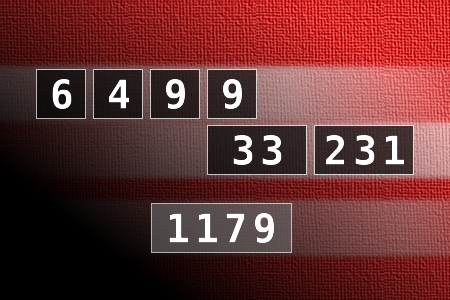
Calculate the number 1179
[7120] Calculate the number 1179 - NUMBERMANIA: Calculate the number 1179 using numbers [6, 4, 9, 9, 33, 231] and basic arithmetic operations (+, -, *, /). Each of the numbers can be used only once. - #brainteasers #math #numbermania - Correct Answers: 3
BRAIN TEASERS
enter your answer and press button OK

Calculate the number 1179

NUMBERMANIA: Calculate the number 1179 using numbers [6, 4, 9, 9, 33, 231] and basic arithmetic operations (+, -, *, /). Each of the numbers can be used only once.
Correct answers: 3
#brainteasers #math #numbermania
Register with your Google Account and start collecting points.
Check your ranking on list.

Kids in the back seat cause ac...

Kids in the back seat cause accidents; accidents in the back seat cause kids.
Never take life seriously. Nobody gets out alive, anyway.
An unbreakable toy is useful for breaking other toys.
Good health is merely the slowest possible rate at which one can die.
If FED EX and UPS were to merge, would they call it EF'D UP?
Everyone has a photographic memory; it's just that some of us are out of film.
How much deeper would the oceans be without sponges?
If quitters never win and winners never quit, what fool came up with, "Quit while your ahead"?!
If a deaf kid swears, does his mother wash his hands with soap?
If a turtle doesn't have a shell, is he homeless or naked?
What would a chair look like, if your knees bent the other way?
What do you do when you see an endangered animal eating an endangered plant?
Jokes of the day - Daily updated jokes. New jokes every day.
Follow Brain Teasers on social networks

Brain Teasers

puzzles, riddles, mathematical problems, mastermind, cinemania...

Jerome Bruner

Born 1 Oct 1915. Jerome Seymour Bruner is an American psychologist who pioneered techniques for investigating infant perception. His investigations of various aspects of cognition, learning and memory in young children complimented the studies made by Jean Piaget. Their work was influential on education in America. Bruner observes that “there is no unique sequence for all learners, and the optimum in any particular case will depend upon a variety of factors, including past learning, stage of development, nature of the material, and individual differences.”«
This site uses cookies to store information on your computer. Some are essential to help the site properly. Others give us insight into how the site is used and help us to optimize the user experience. See our privacy policy.