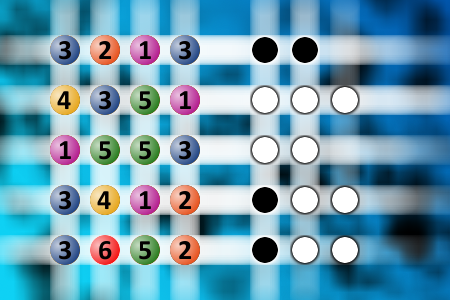
What a winning combination?
[7226] What a winning combination? - The computer chose a secret code (sequence of 4 digits from 1 to 6). Your goal is to find that code. Black circles indicate the number of hits on the right spot. White circles indicate the number of hits on the wrong spot. - #brainteasers #mastermind - Correct Answers: 7
BRAIN TEASERS
enter your answer and press button OK

What a winning combination?

The computer chose a secret code (sequence of 4 digits from 1 to 6). Your goal is to find that code. Black circles indicate the number of hits on the right spot. White circles indicate the number of hits on the wrong spot.
Correct answers: 7
#brainteasers #mastermind
Register with your Google Account and start collecting points.
Check your ranking on list.

A group of third, fourth and f...

A group of third, fourth and fifth graders accompanied by two female teachers went on a field trip to the local racetrack to learn about thoroughbred horses and the supporting industry.
During the tour some of the children wanted to go to the toilet so it was decided that the girls would go with one teacher and the boys would go with the other.
As the teacher assigned to the boys waited outside the men's toilet, one of the boys came out and told her he couldn't reach the urinal. Having no choice, she went inside and began hoisting the little boys up by their armpits, one by one.
As she lifted one, she couldn't help but notice that he was unusually well endowed for an elementary school child.
"I guess you must be in the fifth," she said.
"No ma'am," he replied, "I'm in the seventh, riding Silver Arrow. Thanks for the lift anyhow."
Jokes of the day - Daily updated jokes. New jokes every day.
Follow Brain Teasers on social networks

Brain Teasers

puzzles, riddles, mathematical problems, mastermind, cinemania...

Gerhard Herzberg

Born 25 Dec 1904; died 3 Mar 1999 at age 94.German-Canadian physicist who was awarded the 1971 Nobel Prize for Chemistry "for his contributions to the knowledge of electronic structure and geometry of molecules, particularly free radicals." He published his first work in molecular spectroscopy at the end of the 1920's. His measurement of how molecules absorb ultraviolet and infrared energy yield information on energy states in molecules, leading to knowledge of their size, shape and other properties. For example, he showed that radicals can drastically change their shape with increasing energy, such as methylene which is linear in its ground state but bent in higher energy states. He also applied spectroscopy in astronomy, identifying molecules in space, planetary atmospheres and comets.«
This site uses cookies to store information on your computer. Some are essential to help the site properly. Others give us insight into how the site is used and help us to optimize the user experience. See our privacy policy.