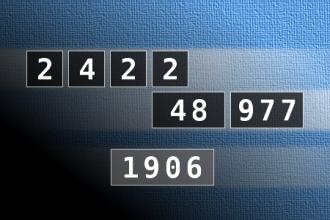
Calculate the number 1906
[7225] Calculate the number 1906 - NUMBERMANIA: Calculate the number 1906 using numbers [2, 4, 2, 2, 48, 977] and basic arithmetic operations (+, -, *, /). Each of the numbers can be used only once. - #brainteasers #math #numbermania - Correct Answers: 2
BRAIN TEASERS
enter your answer and press button OK

Calculate the number 1906

NUMBERMANIA: Calculate the number 1906 using numbers [2, 4, 2, 2, 48, 977] and basic arithmetic operations (+, -, *, /). Each of the numbers can be used only once.
Correct answers: 2
#brainteasers #math #numbermania
Register with your Google Account and start collecting points.
Check your ranking on list.

New-Fangled Ideas

An elderly priest was speaking to a younger priest. "You had a good idea to replace the first four pews with plush bucket theatre seats. It worked like a charm! The front of the church always fills first now."As the young priest nodded, the old priest continued, “You also told me to assign a little more beat to the music because it would bring young people back to church. So, I supported you when you bought in that rock ‘n’ roll Gospel choir. Now, our services are consistently packed.“"Thank you, Father," answered the young priest. "I am pleased that you are open to the new ideas of youth.""All of these ideas have been well and good," said the elderly priest. "But, I'm afraid you've gone too far with the drive-thru confessional." "But Father," protested the young priest. "My confessions and donations have nearly doubled since I began that!""Yes," replied, the elderly priest. "I appreciate that, but the flashing neon sign, ‘Toot 'n’ Tell or Go to Hell’ cannot stay on the church roof!"-
Jokes of the day - Daily updated jokes. New jokes every day.
Follow Brain Teasers on social networks

Brain Teasers

puzzles, riddles, mathematical problems, mastermind, cinemania...

Maurice Ewing

Born 12 May 1906; died 4 May 1974 at age 67.William Maurice Ewing was an American geologist and geophysicist who made fundamental contributions to understanding of marine sediments and ocean basins. He worked in a range of subjects, making contributions to earthquake seismology, explosion seismology, marine acoustics, sedimentology, and tectonics. He adapted seismic exploration methods to use in the oceans; explicated a large segment of the earthquake seismogram, the coda; did studies of Earth's free oscillations; and described the ocean sound channel and the dispersion of sound in seawater. He also developed or greatly improved the bathythermograph, the piston corer, heat-flow probes, sonar, hydrophones, gravimeters and deep-sea cameras.
This site uses cookies to store information on your computer. Some are essential to help the site properly. Others give us insight into how the site is used and help us to optimize the user experience. See our privacy policy.