What a winning combination?
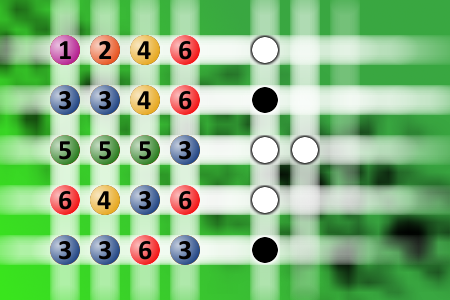
[7452] What a winning combination? - The computer chose a secret code (sequence of 4 digits from 1 to 6). Your goal is to find that code. Black circles indicate the number of hits on the right spot. White circles indicate the number of hits on the wrong spot. - #brainteasers #mastermind - Correct Answers: 3
BRAIN TEASERS
enter your answer and press button OK

What a winning combination?

The computer chose a secret code (sequence of 4 digits from 1 to 6). Your goal is to find that code. Black circles indicate the number of hits on the right spot. White circles indicate the number of hits on the wrong spot.
Correct answers: 3
#brainteasers #mastermind
Register with your Google Account and start collecting points.
Check your ranking on list.

In school one day, the teacher...

In school one day, the teacher decided that for science class she would teach about raw materials. She stood in the front of the class and said,
"Children, if you could have one raw material in the world, what would it be?"
Little Stevie raised his hand and said "I would want gold, because gold is worth a lot of money and I could buy a Corvette."
The teacher nodded and called on little Susie. Little Susie said, "I would want platinum because platinum is worth more than gold and I could buy a Porsche"
The teacher smiled and then called on Little Adam. Little Adam stood up and said, "I would want silicon."
The teacher said, "Adam, why silicon?"
"Because my mom has two bags of it and you should see all the sports cars parked outside of our house!!"
Jokes of the day - Daily updated jokes. New jokes every day.
Follow Brain Teasers on social networks

Brain Teasers

puzzles, riddles, mathematical problems, mastermind, cinemania...

Karen Horney

Died 4 Dec 1952 at age 67 (born 16 Sep 1885). (née Danielsen) German-born American psychoanalyst who departed from some of the basic principles of Sigmund Freud, suggesting that environmental and social conditions, rather than biological drives, determine much of individual personality and are the chief causes of neuroses and personality disorders. While she recognized the importance of early childhood experiences in determining neurotic conflicts, she contended that the analyst must also be aware of current fears and impulses. She also stressed the necessity of understanding the environmental context in which neurotic conflicts are expressed. Her view of human beings allowed much more scope for development and rational adaptation than Freudian determinism permitted.
This site uses cookies to store information on your computer. Some are essential to help the site properly. Others give us insight into how the site is used and help us to optimize the user experience. See our privacy policy.