What a winning combination?
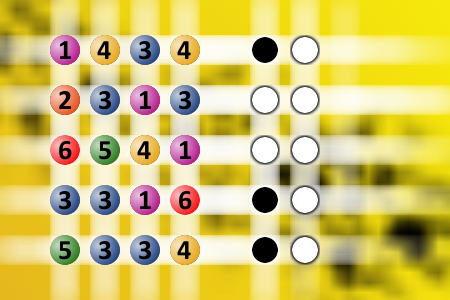
[7459] What a winning combination? - The computer chose a secret code (sequence of 4 digits from 1 to 6). Your goal is to find that code. Black circles indicate the number of hits on the right spot. White circles indicate the number of hits on the wrong spot. - #brainteasers #mastermind - Correct Answers: 2
BRAIN TEASERS
enter your answer and press button OK

What a winning combination?

The computer chose a secret code (sequence of 4 digits from 1 to 6). Your goal is to find that code. Black circles indicate the number of hits on the right spot. White circles indicate the number of hits on the wrong spot.
Correct answers: 2
#brainteasers #mastermind
Register with your Google Account and start collecting points.
Check your ranking on list.

Kiss

One day a teacher had a taste test with her students. She picked a little boy to do the first test. She blindfolded him, put a Hershey kiss in his mouth and asked, "Do you know what it is?
"No, I don't," said the little boy
"Okay, I'll give you a clue. It's the thing your daddy wants from your Mom before he goes to work."
Suddenly, a little girl at the back of the room yelled, "Spit it out! It's a piece of ass!"      

Jokes of the day - Daily updated jokes. New jokes every day.
Follow Brain Teasers on social networks

Brain Teasers

puzzles, riddles, mathematical problems, mastermind, cinemania...

Cross-Channel balloon flight

In 1785, Frenchman Jean Pierre Blanchard and American scientist and physician John Jeffries made the first air crossing of the English Channel from England to France in a hot-air balloon - the first international flight. This was the second of two balloon flights Jeffries financed. To accompany him, Jeffries chose Blanchard for his prior experience in balloon flight. The voyage across the Channel was successful, though not without difficulty, because to maintain height they were forced to jettison everything in the basket, including rope and most of their clothes. Their previous flight took place on 30 Nov 1784, in London, for the purpose of taking scientific and meteorological measurements.[Image: Blanchard (L) and Jeffries (R).]
This site uses cookies to store information on your computer. Some are essential to help the site properly. Others give us insight into how the site is used and help us to optimize the user experience. See our privacy policy.