What a winning combination?
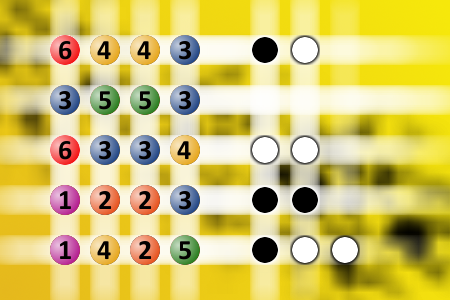
[7765] What a winning combination? - The computer chose a secret code (sequence of 4 digits from 1 to 6). Your goal is to find that code. Black circles indicate the number of hits on the right spot. White circles indicate the number of hits on the wrong spot. - #brainteasers #mastermind - Correct Answers: 3
BRAIN TEASERS
enter your answer and press button OK

What a winning combination?

The computer chose a secret code (sequence of 4 digits from 1 to 6). Your goal is to find that code. Black circles indicate the number of hits on the right spot. White circles indicate the number of hits on the wrong spot.
Correct answers: 3
#brainteasers #mastermind
Register with your Google Account and start collecting points.
Check your ranking on list.

No flight ever leaves on time...

No flight ever leaves on time unless you are running late and need the delay to make the flight.
If you are running late for a flight, it will depart from the farthest gate in the terminal.
If you arrive very early for a flight, it inevitably will be delayed.
Flights never leave from Gate #1 at any terminal in the world.
If you must work on your flight, you will experience turbulence just as soon as you touch pen to paper.
If you are assigned a middle seat, you can determine who has the seats on the aisle and the window while you are still in the boarding area. Just look for the two largest passengers.
Only passengers seated in window seats ever have to get up to go to the washroom.
The crying baby on board your flight is always seated next to you.
The best-looking woman on your flight is never seated next to you.
The less carry-on luggage space available on an aircraft, the more carry-on luggage passengers will bring aboard
Jokes of the day - Daily updated jokes. New jokes every day.
Follow Brain Teasers on social networks

Brain Teasers

puzzles, riddles, mathematical problems, mastermind, cinemania...

Clemens Alexander Winkler

Born 26 Dec 1838; died 8 Oct 1904 at age 65. German chemist who discovered the element germanium (1886). He had a background in managing a cobalt glassworks and then on the faculty of the Freiberg School of Mining. Early in his career, he developed new techniques for industrial gas analysis and developed the Winkler gas burette. When, having been asked by the Freiberg Academy of Mining to analyze the mineral argyrodite (a silver sulphide ore), he found that all the known elements it contained amounted to only 93% of its weight. After spending four months tracking down and isolating the remaining 7%, he found the new element he called germanium, for Germany. This turned out to be the third of the elements (eka-silicon) predicted by Dmitry I. Mendeleyev in 1871.«
This site uses cookies to store information on your computer. Some are essential to help the site properly. Others give us insight into how the site is used and help us to optimize the user experience. See our privacy policy.