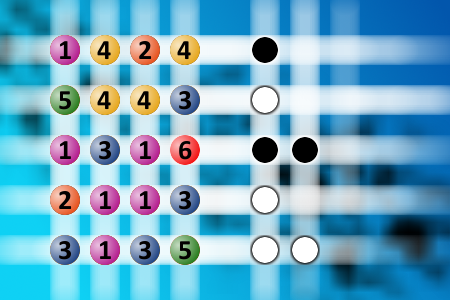

What a winning combination?
[7907] What a winning combination? - The computer chose a secret code (sequence of 4 digits from 1 to 6). Your goal is to find that code. Black circles indicate the number of hits on the right spot. White circles indicate the number of hits on the wrong spot. - #brainteasers #mastermind - Correct Answers: 2
BRAIN TEASERS
enter your answer and press button OK

What a winning combination?

The computer chose a secret code (sequence of 4 digits from 1 to 6). Your goal is to find that code. Black circles indicate the number of hits on the right spot. White circles indicate the number of hits on the wrong spot.
Correct answers: 2
#brainteasers #mastermind
Register with your Google Account and start collecting points.
Check your ranking on list.

The Woman Is On Fire

A lady was filling her tank at a gas station, smoking a cigarette, even though all the signs say not to. The fumes that came out of the gas tank ignited, severely burning her hands.
But it also lit up her arm, too!
Instead of rolling on the ground to put it out, she panicked. She took off running down the street.
A police car was at the intersection where it happened and he tried to stop her to put out her arm, but she just kept running and screaming. All the officer could think of doing was to shoot her. This took everyone by surprise. The officer ran over to her and put the fire out, then called for an ambulance.
When questioned about his course of action to stop her, the officer said, "My only thought was to stop her. After all, she was waving a fire-arm."
Jokes of the day - Daily updated jokes. New jokes every day.
Follow Brain Teasers on social networks

Brain Teasers

puzzles, riddles, mathematical problems, mastermind, cinemania...

Henry A. Gleason

Born 2 Jan 1882; died 12 Apr 1975 at age 93. Henry Allan Gleason was an American botanist who was was active with the New York Botanical Garden for 32 years (1918-1950). By age 13, he already was a botany enthusiast. While still in high school, he contributed to The American Naturalist. Early in his career, he travelled to the Philippines, Java and Ceylon to studying tropical vegetation. In 1918, he gave a lecture on his findings, which led to the offer of a permanent position at NYBG, where he developed its South American collection.He was one of the first to consider community ecology. His paper on “The Individualistic Concept of the Plant Association” (1926) concluded that species tended to distribute themselves independently of one another. Eventually, his idea was embraced for the study of vegetation on an ecological and geographical basis. After retirement, he became emeritus head curator.«
This site uses cookies to store information on your computer. Some are essential to help the site properly. Others give us insight into how the site is used and help us to optimize the user experience. See our privacy policy.