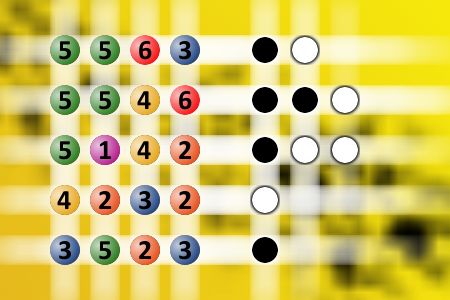
What a winning combination?
[7980] What a winning combination? - The computer chose a secret code (sequence of 4 digits from 1 to 6). Your goal is to find that code. Black circles indicate the number of hits on the right spot. White circles indicate the number of hits on the wrong spot. - #brainteasers #mastermind - Correct Answers: 1
BRAIN TEASERS
enter your answer and press button OK

What a winning combination?

The computer chose a secret code (sequence of 4 digits from 1 to 6). Your goal is to find that code. Black circles indicate the number of hits on the right spot. White circles indicate the number of hits on the wrong spot.
Correct answers: 1
#brainteasers #mastermind

Register with your Google Account and start collecting points.
Check your ranking on list.

World Art Day Joke

Today is World Art Day! Find a joke about it!

What do you call someone hanging out by the wall?
Art.

Why couldn’t the man afford expensive art?
He had no Monet.

Why was the artist hauled to court?
To face the mosaic.

What is Salvador Dali’s favorite thing to eat for breakfast?
A bowl of surreal.

Which famous painting is always sad?
The Moaning Lisa.

Why did Van Gogh become a painter?
Because he didn’t have an ear for music.

What sound does a dog that’s really into art make?
He doesn’t bark. He bauhaus.

Why did the artist decide not to quit running?
He was on the home sketch.

What is it called when someone mislabels a color?
A false ac-hue-sation.

Why did the investor buy art?
For art appreciation.

#worldartday

Jokes of the day - Daily updated jokes. New jokes every day.
Follow Brain Teasers on social networks

Brain Teasers

puzzles, riddles, mathematical problems, mastermind, cinemania...

Clyde E. Wiegand

Born 23 May 1915; died 5 Jul 1996 at age 81.American physicist who worked on the Manhattan Project (which produced the atomic bomb during WW II). In the 1950's, he was part of a team that discovered the antiproton, using the bevatron particle accelerator at Lawrence Berkeley National Laboratory. Although two other members of the research team (Owen Chamberlain and Emilio Segrè) won the 1959 Nobel Prize in Physics for this work, Wiegand's crucial contribution was not so recognized.
This site uses cookies to store information on your computer. Some are essential to help the site properly. Others give us insight into how the site is used and help us to optimize the user experience. See our privacy policy.