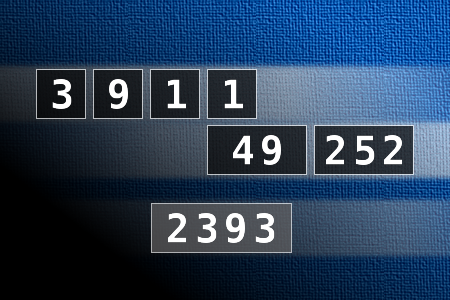
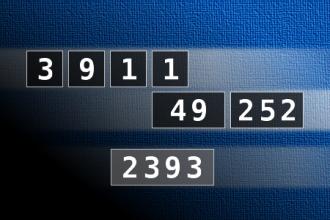
Calculate the number 2393
[8133] Calculate the number 2393 - NUMBERMANIA: Calculate the number 2393 using numbers [3, 9, 1, 1, 49, 252] and basic arithmetic operations (+, -, *, /). Each of the numbers can be used only once. - #brainteasers #math #numbermania - Correct Answers: 1
BRAIN TEASERS
enter your answer and press button OK

Calculate the number 2393

NUMBERMANIA: Calculate the number 2393 using numbers [3, 9, 1, 1, 49, 252] and basic arithmetic operations (+, -, *, /). Each of the numbers can be used only once.
Correct answers: 1
#brainteasers #math #numbermania
Register with your Google Account and start collecting points.
Check your ranking on list.

Try To Explain Women

A man dies and goes to Heaven. He gets to meet GOD and asks GOD if he can ask him a few questions.
"Sure," GOD says, "Go right ahead".
"OK," the man says. "Why did you make women so pretty?"
GOD says, "So you would like them."
"OK," the guy says. "But how come you made them so beautiful?"
"So you would LOVE them", GOD replies.
The man ponders a moment and then asks, "But why did you make them such airheads?"
GOD says, "So they would love you!"
Jokes of the day - Daily updated jokes. New jokes every day.
Follow Brain Teasers on social networks

Brain Teasers

puzzles, riddles, mathematical problems, mastermind, cinemania...

Heber Curtis

Born 27 Jun 1872; died 9 Jan 1942 at age 69. Heber Doust Curtis was an American astronomer who is famed for debating Harlow Shapley on 26 Apr 1920 before the National academy of Sciences. He spoke for “island universes”—whereby spiral nebulae were composed of stars, and represented galaxies far outside the Milky Way. Shapley disagreed, believing that our galaxy was 300,000 light-years in diameter and included the spiral nebulae. By the end of 1924, Curtis was shown to be correct, when a paper from Edwin Hubble was read to the American Astronomical Society on 1 Jan 1925. Curtis had joined Lick Observatory after completing his Ph.D. in 1902. After his early work measuring radial velocities of the brighter stars, but in 1910 he became active in nebular photography, trying to find evidence of their nature as isolated independent star systems.«
This site uses cookies to store information on your computer. Some are essential to help the site properly. Others give us insight into how the site is used and help us to optimize the user experience. See our privacy policy.