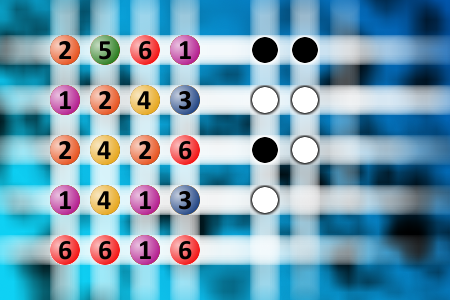

What a winning combination?
[8252] What a winning combination? - The computer chose a secret code (sequence of 4 digits from 1 to 6). Your goal is to find that code. Black circles indicate the number of hits on the right spot. White circles indicate the number of hits on the wrong spot. - #brainteasers #mastermind - Correct Answers: 0
BRAIN TEASERS
enter your answer and press button OK

What a winning combination?

The computer chose a secret code (sequence of 4 digits from 1 to 6). Your goal is to find that code. Black circles indicate the number of hits on the right spot. White circles indicate the number of hits on the wrong spot.
Correct answers: 0
#brainteasers #mastermind
Register with your Google Account and start collecting points.
Check your ranking on list.

The Cab Ride

A cab driver pulled up at a stop sign near Central Park in New York. A stark naked woman jumped out from behind a bush, opened the back door of the cab and demanded to be taken to the airport. The cab driver kept looking back at his passenger in the rear view mirror, and she became irritated and said, "Why do you keep staring at me?" The cab driver replied, "Well, you don't have any clothes on and no place to carry any money and I am wondering how you are going to pay your fare?"
The woman opened her legs and pointed to her crotch and said, "How about me paying with this?"
The cab driver looked back at the woman and said, "Do you have anything smaller?"    

Jokes of the day - Daily updated jokes. New jokes every day.
Follow Brain Teasers on social networks

Brain Teasers

puzzles, riddles, mathematical problems, mastermind, cinemania...

Dennis Flanagan

Died 14 Jan 2005 at age 85 (born 22 Jul 1919). American editor who steered the Scientific American for 37 years (1947-84) and established a new style for the magazine of inviting scientists to write its articles, with support from an editor and illustrator, aimed at the general reader. Those writers included such eminent scientists as Albert Einstein, Linus Pauling and J. Robert Oppenheimer. The first issue of Scientific American was on 28 Aug 1845, but it was the new leadership of new owners (1847), Orson Munn and Alfred Eli Beach, who made it prospect. A century later, Flanagan rescued the magazine in the post WW II years when it was failing financially. With partners and investors, and his editorial innovation, the circulation rose from 40,000 to 600,000 by the time he retired. Flanagan had lost his hearing at age 9, but learned to lip-read.«
This site uses cookies to store information on your computer. Some are essential to help the site properly. Others give us insight into how the site is used and help us to optimize the user experience. See our privacy policy.