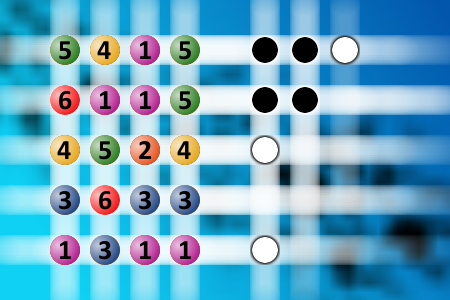
What a winning combination?
[8625] What a winning combination? - The computer chose a secret code (sequence of 4 digits from 1 to 6). Your goal is to find that code. Black circles indicate the number of hits on the right spot. White circles indicate the number of hits on the wrong spot. - #brainteasers #mastermind - Correct Answers: 0
BRAIN TEASERS
enter your answer and press button OK

What a winning combination?

The computer chose a secret code (sequence of 4 digits from 1 to 6). Your goal is to find that code. Black circles indicate the number of hits on the right spot. White circles indicate the number of hits on the wrong spot.
Correct answers: 0
#brainteasers #mastermind
Register with your Google Account and start collecting points.
Check your ranking on list.

This Guy’s Got His Panhandling Strategy Sorted

Jose and Carlos are panhandlers that panhandle in different areas of town.
Carlos panhandles just as long as Jose but only collects $2-3 every day.
Jose brings home a suitcase FULL of $10 bills every day, drives a Mercedes, lives in a mortgage-free house and has a lot of money to spend.
One day, Carlos asked Jose: “I work just as long and hard as you do, but how do you bring home a suitcase full of $10 bills every day?”
“Look at your sign, what does it say?” replies Jose.
Carlos’ sign reads: “I have no work, a wife and six kids to support.”
Jose says: “no wonder you only get $2-3.”
‘Carlos says: “So what does your sign say then?”
Jose shows Carlos his sign – it reads: “I only need another $10 to move back to Mexico”

Jokes of the day - Daily updated jokes. New jokes every day.
Follow Brain Teasers on social networks

Brain Teasers

puzzles, riddles, mathematical problems, mastermind, cinemania...

Willard Harrison Bennett

Died 28 Sep 1987 at age 84 (born 13 Jun 1903).Willard Harrison Bennett was an American physicist who discovered (1934) the pinch effect, an electromagnetic process that may offer a way to magnetically confine a plasma at temperatures high enough for controlled nuclear fusion reactions to occur. He proposed (1936) the tandem Van de Graaff accelerator, which later became widely used in nuclear research. He invented a radio-frequency mass spectrometer, developed in 1955. Since it required no heavy magnet, it was the first launched into space to measure the masses of atoms. Sputnik III carried the first R-F mass spectrometer into space. It was the only space instrument used by the Russians and credited to an American inventor in their own Russian-language publications.
This site uses cookies to store information on your computer. Some are essential to help the site properly. Others give us insight into how the site is used and help us to optimize the user experience. See our privacy policy.