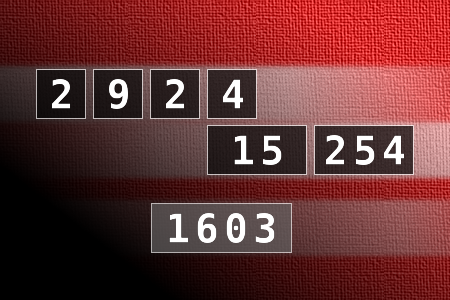
Calculate the number 1603
[8624] Calculate the number 1603 - NUMBERMANIA: Calculate the number 1603 using numbers [2, 9, 2, 4, 15, 254] and basic arithmetic operations (+, -, *, /). Each of the numbers can be used only once. - #brainteasers #math #numbermania - Correct Answers: 0
BRAIN TEASERS
enter your answer and press button OK

Calculate the number 1603

NUMBERMANIA: Calculate the number 1603 using numbers [2, 9, 2, 4, 15, 254] and basic arithmetic operations (+, -, *, /). Each of the numbers can be used only once.
Correct answers: 0
#brainteasers #math #numbermania
Register with your Google Account and start collecting points.
Check your ranking on list.

A man and a woman had been dat...

A man and a woman had been dating for about a year, and their relationship was getting serious. The man proposed marriage, and she accepted. However, she told him that she wanted him to know that her chest was just like a baby's. He said that he loved her and that her measurements didn't matter to him. He told her that his penis was also like a baby's. She said that she loved him and that size didn't matter.
Come the day of their wedding, all went well. That night, the happy couple checked into the honeymoon suite at a resort hotel. The blushing bride was in the bathroom putting on a sexy nightie. Her husband was in bed waiting. As she entered the bedroom, she reminded him of her confession about her chest being like a baby.
"Don't worry, honey," he said.
She took her nightgown off, and her breasts were the smallest he had ever seen. He said that he was going to get undressed and reminded her of his confession about his penis being like a baby.
As he took his pants off, the new bride said, "Oh my!!! I thought you said your penis was like a baby!"
"It is," he said, "9 pounds and 21 inches long!"
Jokes of the day - Daily updated jokes. New jokes every day.
Follow Brain Teasers on social networks

Brain Teasers

puzzles, riddles, mathematical problems, mastermind, cinemania...

Dvorak keyboard

In 1936, the Dvorak typewriter keyboard was patented in the U.S. by Dvorak and Dealey (Patent No. 2,040,248). The efficiency experts August Dvorak (a cousin of the composer) and William Dealey studied the typewriter to determine that they could arrange the keys in a new way which would speed up the operators of the typewriter. They designed a keyboard to maximize efficiency by placing common letters on the home row, and make the stronger fingers of the hands do most of the work. By contrast, the original QWERTY layout was designed for the earlier, less efficient typewriters. Previously, speed would result in two type bars hitting each other in their travel, so the original keyboard was laid out to reduce collisions.
This site uses cookies to store information on your computer. Some are essential to help the site properly. Others give us insight into how the site is used and help us to optimize the user experience. See our privacy policy.