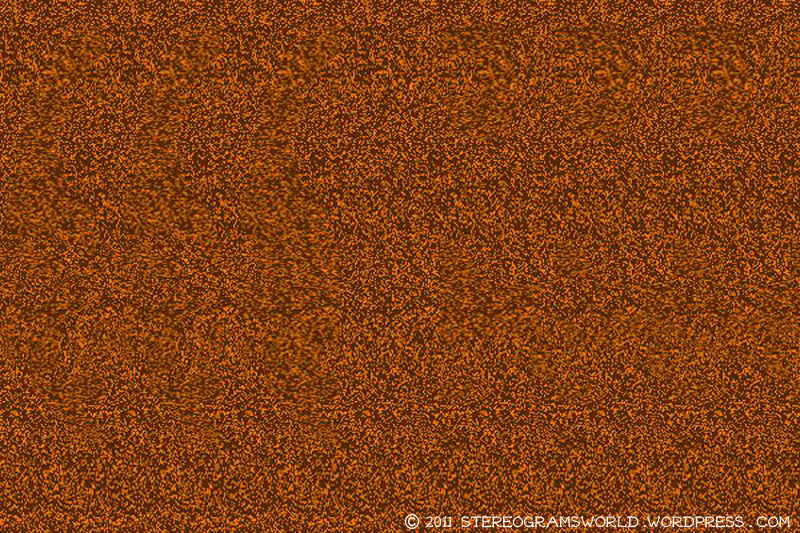

What hides this stereogram?
[3640] What hides this stereogram? - Stereogram - 3D Image - #brainteasers #stereogram #3Dimage
BRAIN TEASERS

What hides this stereogram?

Stereogram - 3D Image
#brainteasers #stereogram #3Dimage
Register with your Google Account and start collecting points.
Check your ranking on list.

Casino Money

A man spent a weekend gambling in Las Vegas casinos, and he won $100,000. He didn't want anyone to know about it, so whan he came back home, he immediately went out to the backyard of his house, dug a hole and planted the money in it.
The next morning he walked outside and found only an empty hole. He noticed footsteps leading from the hole to the house next door, which was owned by a deaf-mute. On the same street lived a professor who understood sign language and was a friend of the deaf man. Grabbing his pistol, the enraged man went to awaken the professor and dragged him to the deaf man's house. He screamed at the professor:
"You tell this guy that if he doesn't give me back my money I'll kill him!"
The professor conveyed the message to his friend, and his friend replied in sign language: "I hid it in my backyard, underneath the cherry tree."

The professor turned to the man with the gun and said: "He's not going to tell you. He said he'd rather die first."

Jokes of the day - Daily updated jokes. New jokes every day.
Follow Brain Teasers on social networks

Brain Teasers

puzzles, riddles, mathematical problems, mastermind, cinemania...

Calcium carbide process patent

In 1895, Thomas L. Willson received a U.S. patent on the “Calcium-Carbide Process” (No. 541,137) that he had accidentally discovered on 2 May 1892. The patent describes the use of an electric arc furnace to produce calcium carbide from a mixture of finely divided coke and lime. It is produced in molten form, which is then tapped and allowed to cool into a crystalline mass. On the same day, he was granted a patent for his “Product Existing in Form of Crystalline Calcium Carbide” (No. 541,138). When his priority was changed in court by Wöhler, who had discovered a less practical method to make calcium carbide, it was Willson's patent for the crystalline form than won, on appeal. He assigned the patent to the Electro Gas Co., which eventually became Union Carbide Corp.«
This site uses cookies to store information on your computer. Some are essential to help the site properly. Others give us insight into how the site is used and help us to optimize the user experience. See our privacy policy.