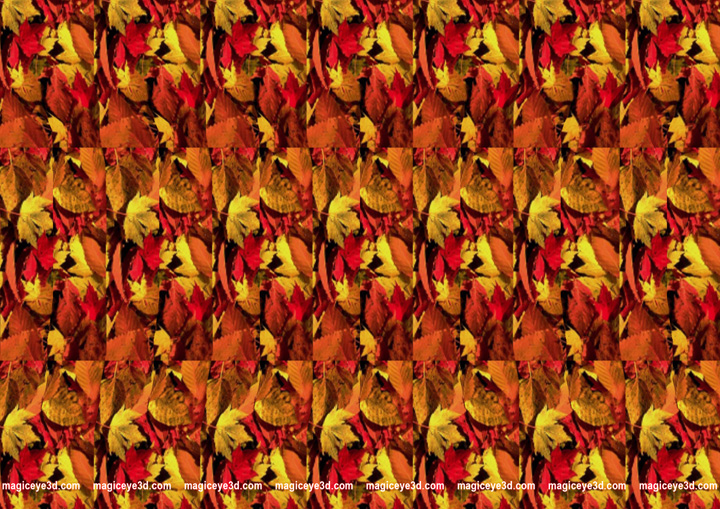
What is hidden in 3D image?
[2985] What is hidden in 3D image? - Stereogram - 3D Image - #brainteasers #stereogram #3Dimage
BRAIN TEASERS

What is hidden in 3D image?

Stereogram - 3D Image
#brainteasers #stereogram #3Dimage
Register with your Google Account and start collecting points.
Check your ranking on list.

Amy, a blonde city girl, marri...

Amy, a blonde city girl, marries a farmer. One morning, on his way out to the fields, the farmer says to Amy, "The artificial insemination man is coming over to impregnate one of our cows today. I drove a nail into the two-by-four just above the cow's stall in the barn. You show him where the cow is when he gets here, okay?" So the farmer leaves for the fields.
After a while, the artificial insemination man arrives and knocks on the front door. Amy takes him down the barn. They walk along long row of cows and when she sees the nail, she tells him, "This is the one. This one right here."
Terribly impressed by what he seemed to think just might be another ditzy blonde, the man asks, "How did you know this is the cow to be bred?"
"That's simple. By the nail over its stall," Amy explains. Then the man asks, "What's the nail for?"
"I guess it's to hang your pants on," she tells him as she walks away.
Jokes of the day - Daily updated jokes. New jokes every day.
Follow Brain Teasers on social networks

Brain Teasers

puzzles, riddles, mathematical problems, mastermind, cinemania...

Flashlight patent

In 1899, a U.S. patent was issued for an "Electric Device," invented by David Misell, which was manufactured as the first tubular "Flash Light" by Conrad Hubert at his American Electrical Novelty and Manufacturing Company (No. 617,592). The limited power of the batteries of the era could only power the inefficient carbon-filament miniature light bulb for brief periods of time between periods of recovery time. As batteries improved, it remained known as a "flashlight" in the U.S., but known as a torch in Britain. Misell was British, but lived in Manhattan, N.Y. at the time of the patent. His design had a tubular case, lens over a reflector and bulb at one end, an switch for intermittent use, used cylindrical batteries contained end-to-end in the now familiar manner, and a removable cap at the other end to insert them.[Image: Detail of head of the flashlight from cross-section patent drawing.]
This site uses cookies to store information on your computer. Some are essential to help the site properly. Others give us insight into how the site is used and help us to optimize the user experience. See our privacy policy.