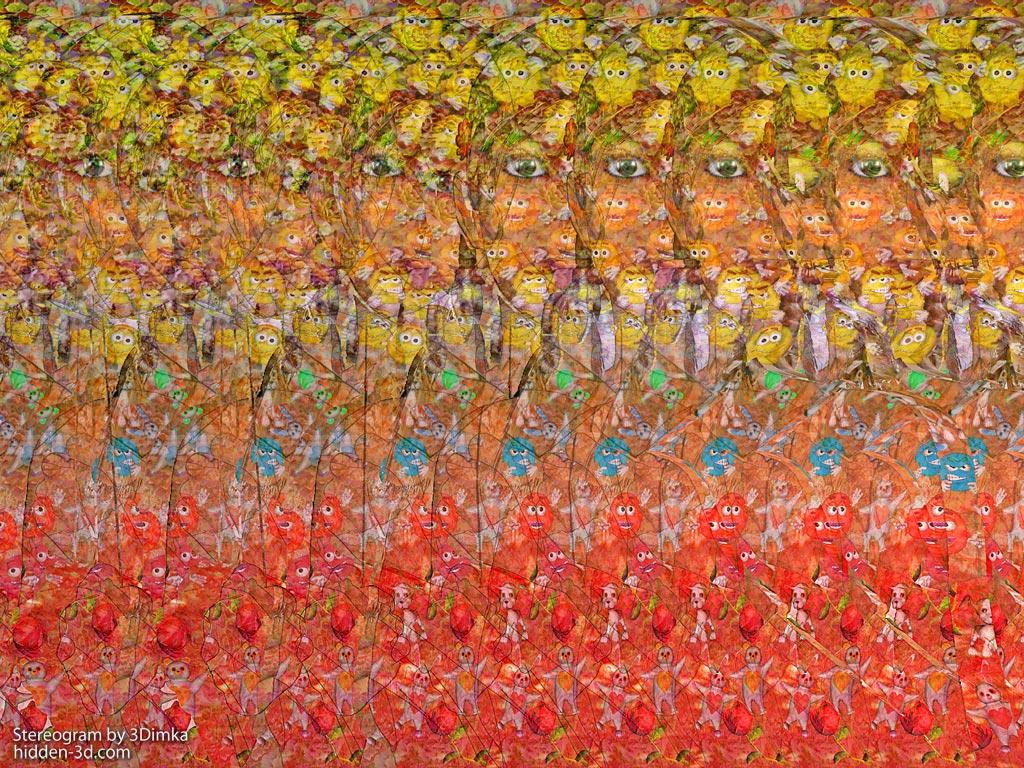

What is hidden in 3D image?
[3933] What is hidden in 3D image? - Stereogram - 3D Image - #brainteasers #stereogram #3Dimage
BRAIN TEASERS

What is hidden in 3D image?

Stereogram - 3D Image
#brainteasers #stereogram #3Dimage
Register with your Google Account and start collecting points.
Check your ranking on list.

Seeing Eye Dog

A blind man is walking down the street with his seeing-eye dog. They come to a busy intersection and the dog, ignoring the high volume of traffic zooming by on the street, leads the blind man right out into thethick of the traffic. This is followed by the screech of tires and horns blaring as panicked drivers try desperately not to run the pair down.
The blind man and the dog finally reach the safety of the sidewalk on other side of the street and the blind man pulls a cookie out of his coat pocket which he offers to the dog.
A passerby, having observed the near fatal incident, can't control his amazement and says to the blind man, "Why on earth are you rewarding your dog with a cookie? He nearly got you killed!"
The blind man turns partially in his direction and replies, "To find out where his head is, so I can kick his ass."    

Jokes of the day - Daily updated jokes. New jokes every day.
Follow Brain Teasers on social networks

Brain Teasers

puzzles, riddles, mathematical problems, mastermind, cinemania...

H.L. Callendar

Died 21 Jan 1930 at age 66 (born 18 Apr 1863).Hugh Longbourne Callendar was an English physicist who was famous for work in calorimetry, thermometry and especially, the thermodynamic properties of steam. He published the first steam tables (1915). In 1886, he invented the platinum resistance thermometer using the electrical resistivity of platinum, enabling the precise measurement of temperatures. He also invented the electrical continuous-flow calorimeter, the compensated air thermometer (1891), a radio balance (1910) and a rolling-chart thermometer (1897) that enabled long-duration collection of climatic temperature data. His son, Guy S. Callendar linked climatic change with increases in carbon dioxide (CO2) resulting from mankind's burning of carbon fuels (1938), known as the Callendar effect, part of the greenhouse effect.«
This site uses cookies to store information on your computer. Some are essential to help the site properly. Others give us insight into how the site is used and help us to optimize the user experience. See our privacy policy.