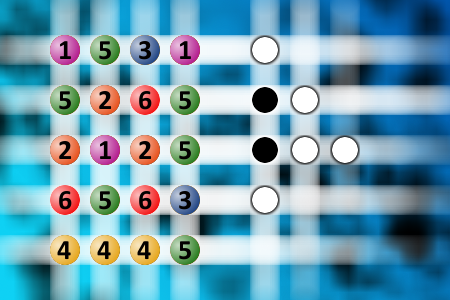
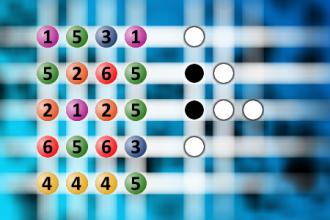
Which is a winning combination of digits?
[3934] Which is a winning combination of digits? - The computer chose a secret code (sequence of 4 digits from 1 to 6). Your goal is to find that code. Black circles indicate the number of hits on the right spot. White circles indicate the number of hits on the wrong spot. - #brainteasers #mastermind - Correct Answers: 40 - The first user who solved this task is Djordje Timotijevic
BRAIN TEASERS
enter your answer and press button OK

Which is a winning combination of digits?

The computer chose a secret code (sequence of 4 digits from 1 to 6). Your goal is to find that code. Black circles indicate the number of hits on the right spot. White circles indicate the number of hits on the wrong spot.
Correct answers: 40
The first user who solved this task is Djordje Timotijevic.
#brainteasers #mastermind
Register with your Google Account and start collecting points.
Check your ranking on list.

White hairs

One day, a girl walks to her mother and look at her mother's hair and sadly said: "Why are some of your hair white mom?"

The mother replied, "Well, every time that you do something wrong and make me cry or unhappy, one of my hairs turns white.

The girl thought about this revelation a while, and then said, "Momma, how come *all* of grandma's hairs are white?"

Jokes of the day - Daily updated jokes. New jokes every day.
Follow Brain Teasers on social networks

Brain Teasers

puzzles, riddles, mathematical problems, mastermind, cinemania...

Alfred Tarski

Born 14 Jan 1902; died 26 Oct 1983 at age 81. Polish-American mathematician and logician who made important studies of general algebra, measure theory, mathematical logic, set theory, and metamathematics. Formal scientific languages can be subjected to more thorough study by the semantic method that he developed. He worked on model theory, mathematical decision problems and with universal algebra. He produced axioms for “logical consequence,” worked on deductive systems, the algebra of logic and the theory of definability. Group theorists study “Tarski monsters,” infinite groups whose existence seems intuitively impossible.
This site uses cookies to store information on your computer. Some are essential to help the site properly. Others give us insight into how the site is used and help us to optimize the user experience. See our privacy policy.