What is seen in the middle o...
[6419] What is seen in the middle o... - What is seen in the middle of March and April that can't be seen at the beginning or end of either month? - #brainteasers #riddles - Correct Answers: 87 - The first user who solved this task is Nasrin 24 T
BRAIN TEASERS
enter your answer and press button OK

What is seen in the middle o...

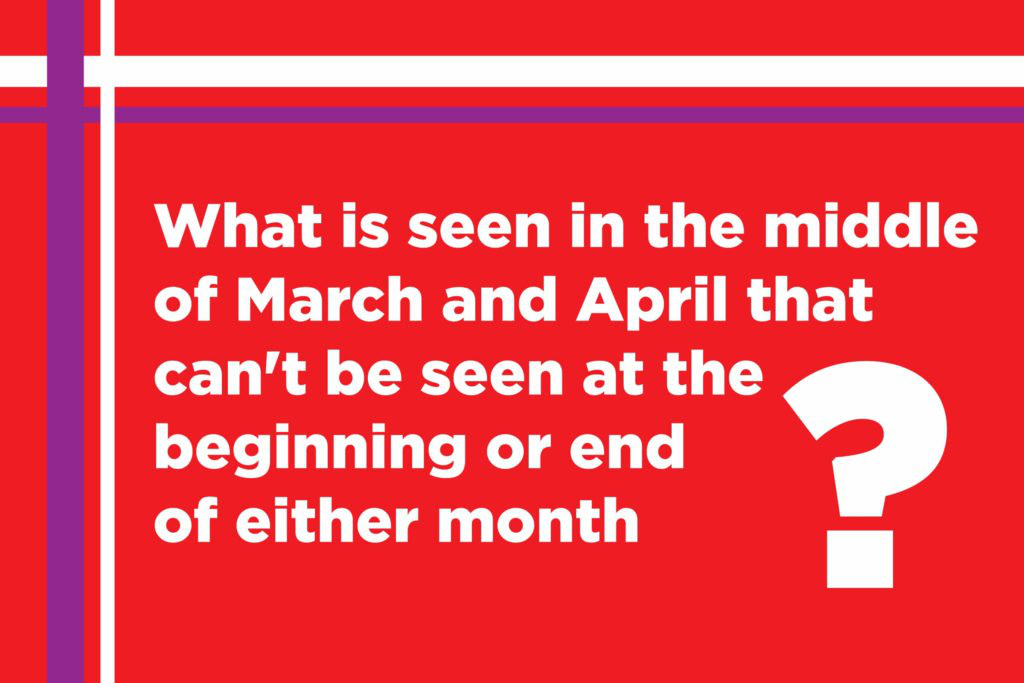
What is seen in the middle of March and April that can't be seen at the beginning or end of either month?
Correct answers: 87
The first user who solved this task is Nasrin 24 T.
#brainteasers #riddles
Register with your Google Account and start collecting points.
Check your ranking on list.

The Umbrella

A 90-year-old man said to his doctor, "I've never felt better. I have an 18-year-old bride who is pregnant with my child. What do you think about that?"
The doctor considered his question for a minute and then said, "I have an elderly friend who is a hunter and never misses a season. One day when he was going out in a bit of a hurry, he accidentally picked up his umbrella instead of his gun. When he got to the Creek, he saw a beaver sitting beside the stream. He raised his umbrella and went, 'bang, bang' and the beaver fell dead. What do you think of that?"
The 90-year-old said, "I'd say somebody else shot that beaver."

The doctor replied, "My point exactly."  

Jokes of the day - Daily updated jokes. New jokes every day.
Follow Brain Teasers on social networks

Brain Teasers

puzzles, riddles, mathematical problems, mastermind, cinemania...

Johann Palisa

Born 6 Dec 1848; died 2 May 1925 at age 76.Austrian astronomer who was a prolific discoverer of asteroids, 122 in all, beginning with Asteroid 136 Austria (on 18 Mar 1874, using a 6" refractor) to Asteroid 1073 Gellivara in 1923 - all by visual observation, without the aid of photography. In 1883, he joined the expedition of the French academy to observe the total solar eclipse on May 6 of that year. During the eclipse, he searched for the putative planet Vulcan, which was supposed to circle the sun within the orbit of Mercury. In addition to observing the eclipse, Palisa collected insects for the Natural History Museum in Vienna. He also prepared two catalogs containing the positions of almost 4,700 stars. He remains the most successful visual discoverer in the history of minor planet research.«
This site uses cookies to store information on your computer. Some are essential to help the site properly. Others give us insight into how the site is used and help us to optimize the user experience. See our privacy policy.