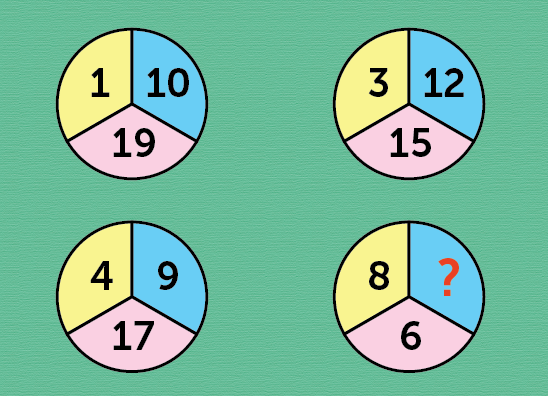
What is the missing number?
[4956] What is the missing number? - MATH PUZZLE: Can you replace the question mark with a number? - #brainteasers #math #riddles - Correct Answers: 95 - The first user who solved this task is Djordje Timotijevic
BRAIN TEASERS
enter your answer and press button OK

What is the missing number?

MATH PUZZLE: Can you replace the question mark with a number?
Correct answers: 95
The first user who solved this task is Djordje Timotijevic.
#brainteasers #math #riddles
Register with your Google Account and start collecting points.
Check your ranking on list.

An English teacher reminds her...

An English teacher reminds her students of the written test in her class tomorrow:
"Now, I don't want anyone to miss this important finals exam! I will not tolerate any excuse whatsoever for your absence--unless of course you had to go to the hospital because of a serious injury, or someone died in your immediate family."
Just after she spoke, a wise ass in the back of the class exclaims: "Well, what if I were to tell you that I didn't show up for the test because I experienced complete and utter sexual exhaustion?"
The students in the class try to suppress their snickers and muffled laughter.
The teacher looks sympathetically towards the young man, smiles slyly and states: "Well, then...you'll have to write with your other hand".
Jokes of the day - Daily updated jokes. New jokes every day.
Follow Brain Teasers on social networks

Brain Teasers

puzzles, riddles, mathematical problems, mastermind, cinemania...

Maria Goeppert-Mayer

Born 28 Jun 1906; died 20 Feb 1972 at age 65. German physicist who shared one-half of the 1963 Nobel Prize for Physics with J. Hans D. Jensen of West Germany for their proposal of the shell nuclear model. (The other half of the prize was awarded to Eugene P. Wigner of the United States for unrelated work.) In 1939 she worked at Columbia University on the separation of uranium isotopes for the atomic bomb project. In 1949, she devised the shell nuclear model, which explained the detailed properties of atomic nuclei in terms of a structure of shells occupied by the protons and neutrons. This explained the great stability and abundance of nuclei that have a particular number of neutrons (such as 50, 82, or 126) and the same special number of protons.
This site uses cookies to store information on your computer. Some are essential to help the site properly. Others give us insight into how the site is used and help us to optimize the user experience. See our privacy policy.