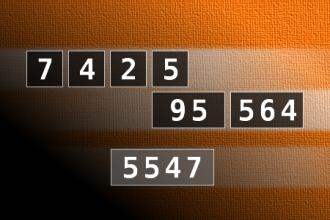
Calculate the number 5547
[6781] Calculate the number 5547 - NUMBERMANIA: Calculate the number 5547 using numbers [7, 4, 2, 5, 95, 564] and basic arithmetic operations (+, -, *, /). Each of the numbers can be used only once. - #brainteasers #math #numbermania - Correct Answers: 13 - The first user who solved this task is Nasrin 24 T
BRAIN TEASERS
enter your answer and press button OK

Calculate the number 5547

NUMBERMANIA: Calculate the number 5547 using numbers [7, 4, 2, 5, 95, 564] and basic arithmetic operations (+, -, *, /). Each of the numbers can be used only once.
Correct answers: 13
The first user who solved this task is Nasrin 24 T.
#brainteasers #math #numbermania
Register with your Google Account and start collecting points.
Check your ranking on list.

A doctor remarked on his patie...

A doctor remarked on his patients, ruddy, very red complexion.
"I know," said the patient, "it's from high blood pressure and it's from my family."
"Your mothers side or fathers side?" questioned the doctor.
"Neither, my wife's side."
"What do you mean?" the doctor said, "That cannot be. How can you get it from your wife's family?"
"Oh yeah, definitely," the patient responded, "you should meet them sometime!"
Jokes of the day - Daily updated jokes. New jokes every day.
Follow Brain Teasers on social networks

Brain Teasers

puzzles, riddles, mathematical problems, mastermind, cinemania...

Frank Harold Spedding

Born 22 Oct 1902; died 15 Dec 1984 at age 82.American chemist who, during the 1940s and '50s, developed processes for reducing individual rare-earth elements to the metallic state at low cost, thereby making these substances available to industry at reasonable prices. Earlier, upon the discovery of nuclear fission in 1939, the U.S. government asked leading scientists to join in the development of nuclear energy. In 1942, Iowa State College's Frank H. Spedding, an expert in the chemistry of rare earths, agreed to set up the Ames portion of the Manhattan Project, resulting in an easy and inexpensive procedure to produce high quality uranium. Between 1942 and 1945, almost two million pounds of uranium was processed on campus, in the old Popcorn Laboratory.
This site uses cookies to store information on your computer. Some are essential to help the site properly. Others give us insight into how the site is used and help us to optimize the user experience. See our privacy policy.