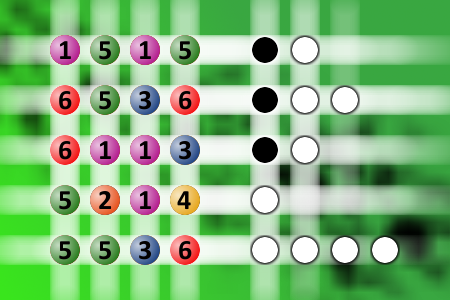
Which is a winning combination of digits?
[1776] Which is a winning combination of digits? - The computer chose a secret code (sequence of 4 digits from 1 to 6). Your goal is to find that code. Black circles indicate the number of hits on the right spot. White circles indicate the number of hits on the wrong spot. - #brainteasers #mastermind - Correct Answers: 76 - The first user who solved this task is Sanja Šabović
BRAIN TEASERS
enter your answer and press button OK

Which is a winning combination of digits?

The computer chose a secret code (sequence of 4 digits from 1 to 6). Your goal is to find that code. Black circles indicate the number of hits on the right spot. White circles indicate the number of hits on the wrong spot.
Correct answers: 76
The first user who solved this task is Sanja Šabović.
#brainteasers #mastermind
Register with your Google Account and start collecting points.
Check your ranking on list.

Home in no time

A woman was waiting in the checkout line at a shopping center. Her arms were heavily laden with a mop and broom and other cleaning supplies. By her actions and deep sighs, it was obvious she was in a hurry and not happy about the slowness of the line.

When the cashier called for a price check on a box of soap, the woman remarked indignantly, "Well, I'll be lucky to get out of here and home before Christmas!"

"Don't worry, ma'am," replied the clerk. "With that wind kicking up out there and that brand new broom you have here, you'll be home in no time."

Jokes of the day - Daily updated jokes. New jokes every day.
Follow Brain Teasers on social networks

Brain Teasers

puzzles, riddles, mathematical problems, mastermind, cinemania...

British Museum

In 1759, the British Museum, in Bloomsbury, London, the world's oldest public national museum, opened to the public who were admitted in small groups, by ticket obtained in advance, for a conducted tour. It was established on 7 Jun 1753 when King George II gave his royal assent to an Act of Parliament on 5 Apr 1753 to acquire the collection of Sir Hans Sloane. In his will, he had offered the nation his lifetime collection of 71,000 objects, mostly plant and animal specimens. In return, he requested £20,000 for his heirs (which today would be over £2,000,000). The present museum buildings date from the mid-19th century. Its natural history collection moved to its own museum in 1881. The British Museum set up a laboratory in 1920 for its scientific studies.[Image: Montagu House, a 17th century mansion, first home of the British Museum.]
This site uses cookies to store information on your computer. Some are essential to help the site properly. Others give us insight into how the site is used and help us to optimize the user experience. See our privacy policy.