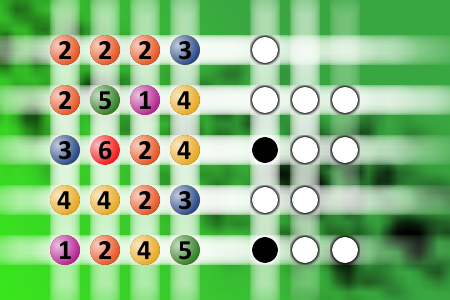
Which is a winning combination of digits?
[1852] Which is a winning combination of digits? - The computer chose a secret code (sequence of 4 digits from 1 to 6). Your goal is to find that code. Black circles indicate the number of hits on the right spot. White circles indicate the number of hits on the wrong spot. - #brainteasers #mastermind - Correct Answers: 57 - The first user who solved this task is Djordje Timotijevic
BRAIN TEASERS
enter your answer and press button OK

Which is a winning combination of digits?

The computer chose a secret code (sequence of 4 digits from 1 to 6). Your goal is to find that code. Black circles indicate the number of hits on the right spot. White circles indicate the number of hits on the wrong spot.
Correct answers: 57
The first user who solved this task is Djordje Timotijevic.
#brainteasers #mastermind
Register with your Google Account and start collecting points.
Check your ranking on list.

A lady went into a bar in Waco...

A lady went into a bar in Waco and saw a cowboy with his feet propped up on a table. He had the biggest boots she'd ever seen.
The woman asked the cowboy if it's true what they say about men with big feet are well endowed.
The cowboy grinned and said, "Shore is, little lady.Why don't you come on out to the bunkhouse and let me prove it to you?"
The woman wanted to find out for herself, so she spent the night with him.
The next morning she handed him a $100 bill.
Blushing, he said, "Well, thankee, ma'am. Ah'm real flattered. Ain't nobody ever paid me fer mah services before."
"Don't be flattered. Take the money and buy yourself some boots that fit."
Jokes of the day - Daily updated jokes. New jokes every day.
Follow Brain Teasers on social networks

Brain Teasers

puzzles, riddles, mathematical problems, mastermind, cinemania...

Shockley semiconductor amplifier idea

In 1939, William Shockley wrote in his laboratory notebook: “It has today occurred to me that an amplifier using semiconductors rather than vacuum is in principle possible.&rdquo. He went on to develop the transistor, for which he shared (with John Bardeen and Walter Brattain) the 1956 Nobel Prize in Physics.
This site uses cookies to store information on your computer. Some are essential to help the site properly. Others give us insight into how the site is used and help us to optimize the user experience. See our privacy policy.