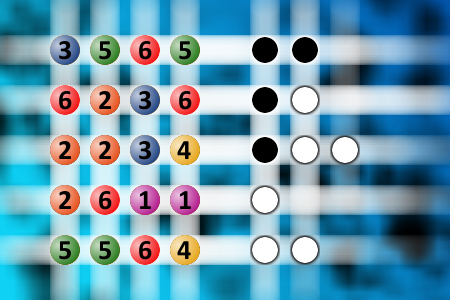
Which is a winning combination of digits?
[4285] Which is a winning combination of digits? - The computer chose a secret code (sequence of 4 digits from 1 to 6). Your goal is to find that code. Black circles indicate the number of hits on the right spot. White circles indicate the number of hits on the wrong spot. - #brainteasers #mastermind - Correct Answers: 31 - The first user who solved this task is Manguexa Wagle
BRAIN TEASERS
enter your answer and press button OK

Which is a winning combination of digits?

The computer chose a secret code (sequence of 4 digits from 1 to 6). Your goal is to find that code. Black circles indicate the number of hits on the right spot. White circles indicate the number of hits on the wrong spot.
Correct answers: 31
The first user who solved this task is Manguexa Wagle.
#brainteasers #mastermind
Register with your Google Account and start collecting points.
Check your ranking on list.

Cured

A woman went to doctor's office for her annual examination.

Suddenly, another older doctor noticed her burst out of the examination room, screaming as she ran down the hall. He stopped the hysterical woman and asked her to sit down and relax. Then, he asked her what she was so upset about.

A few minutes later, the older doctor marched back to the woman's doctor and demanded, "What's the matter with you? Mrs. Terry is 63 years old, she has four grown children, and seven grandchildren... and you told her she was pregnant?"

The woman's doctor smiled smugly as he continued to write on his clipboard, "Cured her hiccups though, didn't I?"

Jokes of the day - Daily updated jokes. New jokes every day.
Follow Brain Teasers on social networks

Brain Teasers

puzzles, riddles, mathematical problems, mastermind, cinemania...

Adolf Meyer

Died 17 Mar 1950 at age 83 (born 13 Sep 1866).Swiss-American psychiatrist (1900-40), whose teaching and influential work has become a part of psychiatric theory and practice in English-speaking countries. Already trained in neuroanatomy and neurophysiology when he emigrated to the U.S. (1892), from working at mental institutions, he began to attribute the disorder in mental illness not to brain pathology, but to a personality dysfunction. He recognized social environment as an influence in mental disorders. Throughout his years at Johns Hopkins University as professor of psychiatry (1910-41), he taught that in the diagnosis and treatment of mental illness, the patient must be evaluated as a whole person.
This site uses cookies to store information on your computer. Some are essential to help the site properly. Others give us insight into how the site is used and help us to optimize the user experience. See our privacy policy.