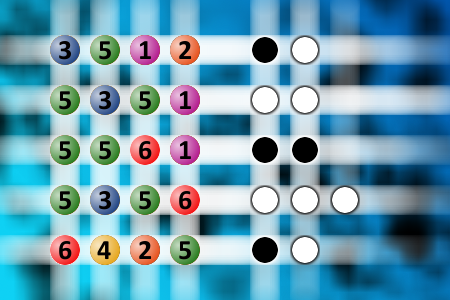
Which is a winning combination of digits?
[4330] Which is a winning combination of digits? - The computer chose a secret code (sequence of 4 digits from 1 to 6). Your goal is to find that code. Black circles indicate the number of hits on the right spot. White circles indicate the number of hits on the wrong spot. - #brainteasers #mastermind - Correct Answers: 35 - The first user who solved this task is Thinh Ddh
BRAIN TEASERS
enter your answer and press button OK

Which is a winning combination of digits?

The computer chose a secret code (sequence of 4 digits from 1 to 6). Your goal is to find that code. Black circles indicate the number of hits on the right spot. White circles indicate the number of hits on the wrong spot.
Correct answers: 35
The first user who solved this task is Thinh Ddh.
#brainteasers #mastermind
Register with your Google Account and start collecting points.
Check your ranking on list.

Insurance

Larry's barn burned down and his wife, Susan, called the insurance company.

Susan told the insurance company, "We had that barn insured for fifty thousand and I want my money."

The agent replied, "Whoa there, just a minute, Susan. Insurance doesn't work quite like that. We will ascertain the value of what was insured and provide you with a new one of comparable worth."

There was a long pause before Susan replied, "Then I'd like to cancel the policy on my husband."

Jokes of the day - Daily updated jokes. New jokes every day.
Follow Brain Teasers on social networks

Brain Teasers

puzzles, riddles, mathematical problems, mastermind, cinemania...

Samuel Abraham Goudsmit

Died 4 Dec 1978 at age 76 (born 11 Jul 1902).Dutch-born U.S. physicist who, with George E. Uhlenbeck, a fellow graduate student at the University of Leiden, Neth., formulated (1925) the concept of electron spin. It led to recognition that spin was a property of protons, neutrons, and most elementary particles and to a fundamental change in the mathematical structure of quantum mechanics. Goudsmit also made the first measurement of nuclear spin and its Zeeman effect with Ernst Back (1926-27), developed a theory of hyperfine structure of spectral lines, made the first spectroscopic determination of nuclear magnetic moments (1931-33), contributed to the theory of complex atoms and the theory of multiple scattering of electrons, and invented the magnetic time-of-flight mass spectrometer (1948).
This site uses cookies to store information on your computer. Some are essential to help the site properly. Others give us insight into how the site is used and help us to optimize the user experience. See our privacy policy.