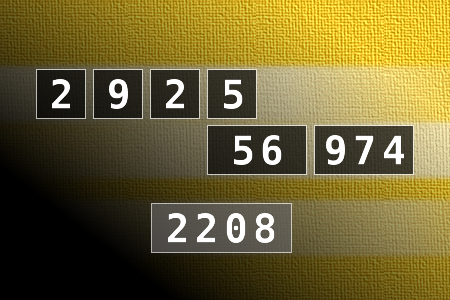
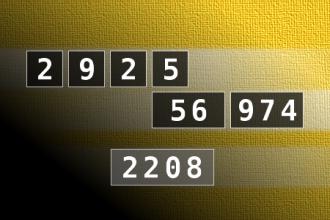
Calculate the number 2208
[4329] Calculate the number 2208 - NUMBERMANIA: Calculate the number 2208 using numbers [2, 9, 2, 5, 56, 974] and basic arithmetic operations (+, -, *, /). Each of the numbers can be used only once. - #brainteasers #math #numbermania - Correct Answers: 19 - The first user who solved this task is Thinh Ddh
BRAIN TEASERS
enter your answer and press button OK

Calculate the number 2208

NUMBERMANIA: Calculate the number 2208 using numbers [2, 9, 2, 5, 56, 974] and basic arithmetic operations (+, -, *, /). Each of the numbers can be used only once.
Correct answers: 19
The first user who solved this task is Thinh Ddh.
#brainteasers #math #numbermania
Register with your Google Account and start collecting points.
Check your ranking on list.

Growing Wild

Here is this guy who really takes care of his body; he lifts weights and jogs five miles every day.

One morning, he looks into the mirror and admires his body. He notices that he is really sun tanned all over except one part and he decides to do something about it.

He goes to the beach, completely undresses and buries himself in the dand except for the one part sticking out.

Two little old ladies are strolling along the beach and one looks down and says, "There really is no justice in this world."

The other little old lady says, "What do you mean?"

The first little old lady says, "Look at that."

"When I was 10 years old, I was afraid of it."

"When I was 20 years old, I was curious about it."

"When I was 30 years old, I enjoyed it."

"When I was 40 years old, I asked for it."

"When I was 50 years old, I paid for it."

"When I was 60 years old, I prayed for it."

"When I was 70 years old, I forgot about it."

"And now that I'm 80, the damned things are growing wild!!"

Jokes of the day - Daily updated jokes. New jokes every day.
Follow Brain Teasers on social networks

Brain Teasers

puzzles, riddles, mathematical problems, mastermind, cinemania...

Wolfgang Paul

Born 10 Aug 1913; died 6 Dec 1993 at age 80.German physicist who developed the Paul trap, an electromagnetic device that captures ions and holds them long enough for study and precise measurement of their properties. During the 1950s he developed the so-called Paul trap as a means of confining and studying electrons. The device consists of three electrodes - two end caps and an encircling ring. The ring is connected to an oscillating potential. The direction of the electric field alternates; for half the time the electron is pushed from the caps to the ring and for the other half it is pulled from the ring and pushed towards the caps. For his work he shared the 1989 Nobel Prize for Physics with Hans Georg Dehmelt and Norman F. Ramsey.
This site uses cookies to store information on your computer. Some are essential to help the site properly. Others give us insight into how the site is used and help us to optimize the user experience. See our privacy policy.