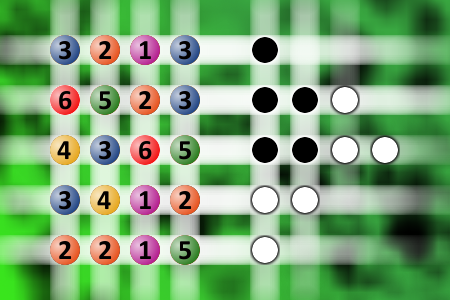

Which is a winning combination of digits?
[4905] Which is a winning combination of digits? - The computer chose a secret code (sequence of 4 digits from 1 to 6). Your goal is to find that code. Black circles indicate the number of hits on the right spot. White circles indicate the number of hits on the wrong spot. - #brainteasers #mastermind - Correct Answers: 29 - The first user who solved this task is Djordje Timotijevic
BRAIN TEASERS
enter your answer and press button OK

Which is a winning combination of digits?

The computer chose a secret code (sequence of 4 digits from 1 to 6). Your goal is to find that code. Black circles indicate the number of hits on the right spot. White circles indicate the number of hits on the wrong spot.
Correct answers: 29
The first user who solved this task is Djordje Timotijevic.
#brainteasers #mastermind
Register with your Google Account and start collecting points.
Check your ranking on list.

BETTER THAN EATING THE EVIDENCE

Morris is at work one day when he notices that his co-worker, Joe, is wearing an earring. This man knows his co-worker to be a normally conservative fellow, and is curious about his sudden change in "fashion sense."

"Hey Joe, he yells out - I didn't know you were into earrings."

"Don't make such a big deal out of it,...it's only an earring." Says Joe sheepishly.

"No really," probes Morris, "How long have you been wearing one?"

"Ever since my wife found it in our bed."

Jokes of the day - Daily updated jokes. New jokes every day.
Follow Brain Teasers on social networks

Brain Teasers

puzzles, riddles, mathematical problems, mastermind, cinemania...

Franz Weidenreich

Died 11 Jul 1948 at age 75 (born 7 Jun 1873).German anatomist and physical anthropologist whose reconstruction of prehistoric human remains and work on Peking man (then called Sinanthropus pekinensis) and other hominids brought him to preeminence in the study of human evolution. A Jew, Weidenreich fled Nazi Germany to take a position in Beijing. He worked with Teilhard de Chardin on the Zhoukoudian fossils (at the Cave of Peking Man), next fleeing the Japanese during WW II. His "multiregional" hypothesis of human origins (i.e., that human racial lineages date back to the early Pleistocene) became influential and is still widely debated, but at first it was misinterpreted as arguing that there was no genetic continuity between human races.
This site uses cookies to store information on your computer. Some are essential to help the site properly. Others give us insight into how the site is used and help us to optimize the user experience. See our privacy policy.