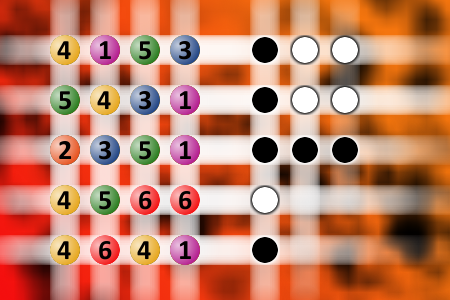
Which is a winning combination of digits?
[5416] Which is a winning combination of digits? - The computer chose a secret code (sequence of 4 digits from 1 to 6). Your goal is to find that code. Black circles indicate the number of hits on the right spot. White circles indicate the number of hits on the wrong spot. - #brainteasers #mastermind - Correct Answers: 43 - The first user who solved this task is Nílton Corrêa De Sousa
BRAIN TEASERS
enter your answer and press button OK

Which is a winning combination of digits?

The computer chose a secret code (sequence of 4 digits from 1 to 6). Your goal is to find that code. Black circles indicate the number of hits on the right spot. White circles indicate the number of hits on the wrong spot.
Correct answers: 43
The first user who solved this task is Nílton Corrêa De Sousa.
#brainteasers #mastermind
Register with your Google Account and start collecting points.
Check your ranking on list.

Do Something Nice

Unable to attend the funeral after his Uncle Charlie died, a man who lived far away called his Blonde brother and told him, 'Do something nice for Uncle Charlie and send me the bill.'
Later, he got a bill for $200.00, which he paid. The next month, he got another bill for $200.00, which he also paid, figuring it was some incidental expense.
But when the $200.00 bills kept arriving every month, he finally called his brother again to find out what was going on.
'Well,' said the Blonde brother, 'you said to do something nice for Uncle Charlie.
So I rented him a tuxedo.'

Jokes of the day - Daily updated jokes. New jokes every day.
Follow Brain Teasers on social networks

Brain Teasers

puzzles, riddles, mathematical problems, mastermind, cinemania...

Paul Crutzen

Born 3 Dec 1933. Paul Josef Crutzen is a Dutch chemist who received the 1995 Nobel Prize for Chemistry for demonstrating, in 1970, that chemical compounds of nitrogen oxide accelerate the destruction of stratospheric ozone, which protects the Earth from the Sun's ultraviolet radiation. His work, published in 1970, that showed that the nitrogen oxides NO and NO2 react catalytically with ozone, thus accelerating the rate of ozone breakdown to O2 in the stratosphere. These nitrogen oxides are formed principally by decay of nitrous oxide (N2O) which originates from microbiological transformations in the soil. He shared the prize with chemists Mario Molina and F. Sherwood Rowland, who discovered in 1974 that manufactured chlorofluorocarbon gases also contribute to ozone depletion.
This site uses cookies to store information on your computer. Some are essential to help the site properly. Others give us insight into how the site is used and help us to optimize the user experience. See our privacy policy.