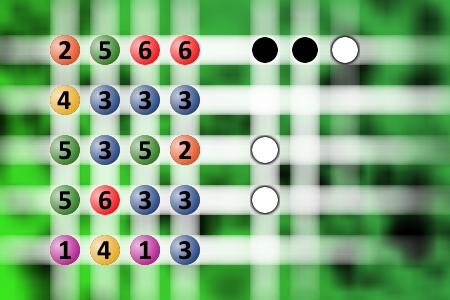
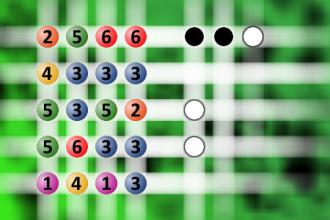
Which is a winning combination of digits?
[6161] Which is a winning combination of digits? - The computer chose a secret code (sequence of 4 digits from 1 to 6). Your goal is to find that code. Black circles indicate the number of hits on the right spot. White circles indicate the number of hits on the wrong spot. - #brainteasers #mastermind - Correct Answers: 23 - The first user who solved this task is Fazil Hashim
BRAIN TEASERS
enter your answer and press button OK

Which is a winning combination of digits?

The computer chose a secret code (sequence of 4 digits from 1 to 6). Your goal is to find that code. Black circles indicate the number of hits on the right spot. White circles indicate the number of hits on the wrong spot.
Correct answers: 23
The first user who solved this task is Fazil Hashim.
#brainteasers #mastermind
Register with your Google Account and start collecting points.
Check your ranking on list.

What are you drawing?

A kindergarten teacher was observing her classroom of children while they drew. She would occasionally walk around to see each child's artwork. As she got to one little girl who was working diligently, she asked what the drawing was.

The girl replied, "I'm drawing God."

The teacher paused and said, "but no one knows what God looks like."

Without missing a beat, or looking up from her drawing the girl replied, "They will in a minute."

Jokes of the day - Daily updated jokes. New jokes every day.
Follow Brain Teasers on social networks

Brain Teasers

puzzles, riddles, mathematical problems, mastermind, cinemania...

Keith Roberts Porter

Born 11 Jun 1912; died 2 May 1997 at age 84.Canadian-born American cell biologist who developed techniques for electron microscope studies to determine the internal structure and organization of cells and tissues. As a graduate student at Harvard, he developed a method for nuclear transplantation in frog eggs. In 1945, he described the structure of the endoplasmic reticulum. In 1952-53, Porter with George Palade and Fritiof Stig Sjöstrand perfected thin sectioning and fixation methods for electron microscopy of intracellular structures, especially of mitochondria. He used scanning electron microscopy for visualizing the surfaces of cells and tissues and applied it both to tissue culture cells, and to organs and tissues that were dispersed by chemical or mechanical treatment.
This site uses cookies to store information on your computer. Some are essential to help the site properly. Others give us insight into how the site is used and help us to optimize the user experience. See our privacy policy.