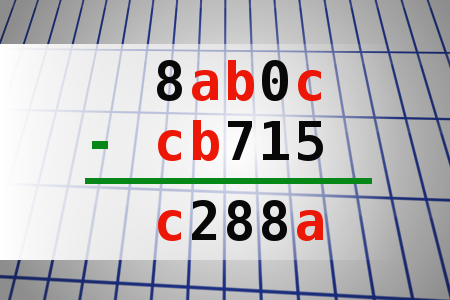
Find number abc
[6162] Find number abc - If 8ab0c - cb715 = c288a find number abc. Multiple solutions may exist. - #brainteasers #math - Correct Answers: 21 - The first user who solved this task is Fazil Hashim
BRAIN TEASERS
enter your answer and press button OK

Find number abc

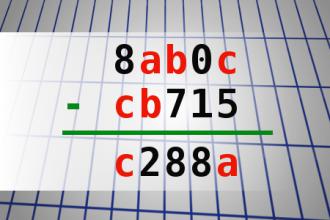
If 8ab0c - cb715 = c288a find number abc. Multiple solutions may exist.
Correct answers: 21
The first user who solved this task is Fazil Hashim.
#brainteasers #math
Register with your Google Account and start collecting points.
Check your ranking on list.

Play a Game

One day little Johnny went to school. His teacher said they were going to play a game. She would place an object behind her and describe it.
The first person to get it got a piece of candy. First she said, "The object is red and grows on trees."
A kid raised his hand and said "an apple" the teacher said correct.
Then she said, "The object is flat and comes in different colors" a different kid raises his hand and said it is a notebook!
The teacher said correct.
Then Johnny said, "ooh! ooh! Can I try?"
The teacher said yes.
He stood up and put his hand in his pocket. He said "The object is round, hard, and has a head on it."
The teacher said "JOHNNY! GO TO THE OFFICE!!"
Johnny said, "No it's a quarter!"  

Jokes of the day - Daily updated jokes. New jokes every day.
Follow Brain Teasers on social networks

Brain Teasers

puzzles, riddles, mathematical problems, mastermind, cinemania...

Eliezer Sukenik

Born 12 Aug 1889; died 28 Feb 1953 at age 63.Eliezer Lipa Sukenik was a Polish-Israeli archaeologist who established the date and provenance of the Dead Sea Scrolls. He settled in Israel in 1912, began teaching in 1914 and eventually became field archaeologist at the Hebrew University. He directed the excavations of the synagogues and Jewish tombs. In 1947, within the eleven caves near Qumran, north-west of the Dead Sea, Israel, parts of more than 700 ancient Jewish manuscripts were discovered. Most were written in Hebrew, some in Aramaic and fewer in Greek. The Dead Sea Scrolls, as they came to be known, are assumed to have been the library of a sectarian community at Qumran. Sukenik devoted the rest of his life to their study.«
This site uses cookies to store information on your computer. Some are essential to help the site properly. Others give us insight into how the site is used and help us to optimize the user experience. See our privacy policy.