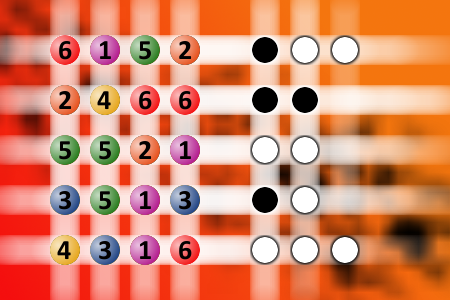
Which is a winning combination of digits?
[6634] Which is a winning combination of digits? - The computer chose a secret code (sequence of 4 digits from 1 to 6). Your goal is to find that code. Black circles indicate the number of hits on the right spot. White circles indicate the number of hits on the wrong spot. - #brainteasers #mastermind - Correct Answers: 24 - The first user who solved this task is Nasrin 24 T
BRAIN TEASERS
enter your answer and press button OK

Which is a winning combination of digits?

The computer chose a secret code (sequence of 4 digits from 1 to 6). Your goal is to find that code. Black circles indicate the number of hits on the right spot. White circles indicate the number of hits on the wrong spot.
Correct answers: 24
The first user who solved this task is Nasrin 24 T.
#brainteasers #mastermind
Register with your Google Account and start collecting points.
Check your ranking on list.

Words to live by

Notice! Take lettuce from the top of the stack,or heads will roll!

Well, if Jerry Springer isn't educational TV,why does it make me feel so much smarter?

A TV can insult your intelligence, but nothingrubs it in like a computer.

I tried to get in touch with my inner child,but he isn't allowed to talk to strangers.

I have to take my paycheck to the bank.It's too little to go by itself.

I must be following my diet too closely.I keep gaining on it.

Welcome to Megacomputer's 24-hour helpline.If you have been waiting LESS than 24 hours,please remain on the line.

Whenever I'm in a mood to watch the world go by,I just keep to the posted speed limit.

Don't sweat the petty things and don't pet the sweaty things.

One tequila, two tequila, three tequila, floor.

If man evolved from monkeys and apes,why do we still have monkeys and apes?

Jokes of the day - Daily updated jokes. New jokes every day.
Follow Brain Teasers on social networks

Brain Teasers

puzzles, riddles, mathematical problems, mastermind, cinemania...

Neanderthal origins

In 1997, the first sequencing of pieces of DNA extracted from a Neanderthal-type specimen was published in the journal Cell, by a team of scientists led by Svent Pääbo.In the groundbreaking study, mitochondrial DNA was amplified from a sample (a small piece of the arm bone) from the first Neanderthal man found (1856). “The Neanderthal sequence falls outside the variation of modern humans.” The results suggested that from their common origin (“African Eve”), Neanderthals split off from humans a little over 550,000 years ago as a separate species and “went extinct without contributing mtDNA to modern humans.” (Using population models, Pääbo, more recently estimated that Neanderthals could have contributed up to 25% of their genetic makeup to modern human, but likely much less.)«[Ref: Cell (11 Jul 1997), 90, No.1, 19-30.]
This site uses cookies to store information on your computer. Some are essential to help the site properly. Others give us insight into how the site is used and help us to optimize the user experience. See our privacy policy.