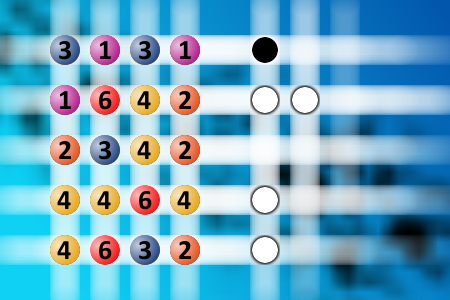
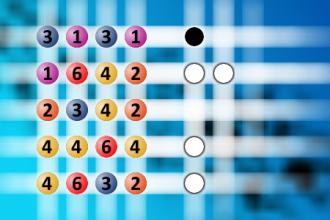
Which is a winning combination of digits?
[6775] Which is a winning combination of digits? - The computer chose a secret code (sequence of 4 digits from 1 to 6). Your goal is to find that code. Black circles indicate the number of hits on the right spot. White circles indicate the number of hits on the wrong spot. - #brainteasers #mastermind - Correct Answers: 45 - The first user who solved this task is Nasrin 24 T
BRAIN TEASERS
enter your answer and press button OK

Which is a winning combination of digits?

The computer chose a secret code (sequence of 4 digits from 1 to 6). Your goal is to find that code. Black circles indicate the number of hits on the right spot. White circles indicate the number of hits on the wrong spot.
Correct answers: 45
The first user who solved this task is Nasrin 24 T.
#brainteasers #mastermind
Register with your Google Account and start collecting points.
Check your ranking on list.

Patton Oswalt: The Apocalypse

Were probably going to die in the f**king apocalypse, but you know whats kind of exciting about that is that if the apocalypse actually goes down -- and I mean the f**king biblical apocalypse -- and if that starts to happen -- I mean, like, the ground opening up and demons flying out and gnawing on your flesh -- it means a couple of things. One: It means that Im wrong, and there is God and there is an afterlife. Two: It means that since there is an afterlife, you will be in the f**king VIP section of the afterlife.
Jokes of the day - Daily updated jokes. New jokes every day.
Follow Brain Teasers on social networks

Brain Teasers

puzzles, riddles, mathematical problems, mastermind, cinemania...

Johann Christian Fabricius

Born 7 Jan 1745; died 3 Mar 1808 at age 63.Danish entomologist who was one of the great entomologists of the 18th century. After studying with Swedish naturalist Linnaeus, Fabricius travelled widely in Europe to see insect collections and produced many publications describing all the new species that he saw. He named and classified some 10,000 species of insects. The system of classification of insects he developed was based on mouth structure (instead of wing). He offered theories, progressive for his time, suggesting that hybridization could produce produce new species or varieties, and that environmental adaptation could influence changes in anatomical structure or function.
This site uses cookies to store information on your computer. Some are essential to help the site properly. Others give us insight into how the site is used and help us to optimize the user experience. See our privacy policy.