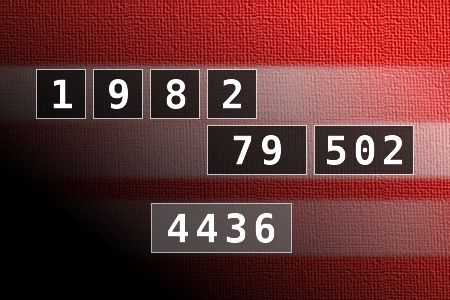
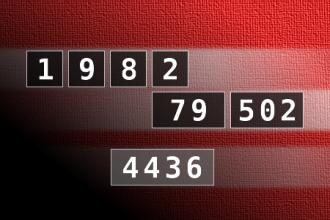
Calculate the number 4436
[6827] Calculate the number 4436 - NUMBERMANIA: Calculate the number 4436 using numbers [1, 9, 8, 2, 79, 502] and basic arithmetic operations (+, -, *, /). Each of the numbers can be used only once. - #brainteasers #math #numbermania - Correct Answers: 12 - The first user who solved this task is Nasrin 24 T
BRAIN TEASERS
enter your answer and press button OK

Calculate the number 4436

NUMBERMANIA: Calculate the number 4436 using numbers [1, 9, 8, 2, 79, 502] and basic arithmetic operations (+, -, *, /). Each of the numbers can be used only once.
Correct answers: 12
The first user who solved this task is Nasrin 24 T.
#brainteasers #math #numbermania
Register with your Google Account and start collecting points.
Check your ranking on list.

Two men went bear hunting. Whi...

Two men went bear hunting. While one stayed in the cabin, the other went out looking for a bear.

He soon found a huge bear, shot at it but only wounded it. The enraged bear charged toward him, he dropped his rifle and started running for the cabin as fast as he could.

He ran pretty fast but the bear was just a little faster and gained on him with every step.

Just as he reached the open cabin door, he tripped and fell flat.

Too close behind to stop, the bear tripped over him and went rolling into the cabin.

The man jumped up, closed the cabin door and yelled to his friend inside, "You skin this one while I go and get another!"
Jokes of the day - Daily updated jokes. New jokes every day.
Follow Brain Teasers on social networks

Brain Teasers

puzzles, riddles, mathematical problems, mastermind, cinemania...

André-Louis Danjon

Born 6 Apr 1890; died 21 Apr 1967 at age 77.French astronomer who devised a now standard five-point scale for rating the darkness and colour of a total lunar eclipse, which is known as the Danjon Luminosity Scale. He studied Earth's rotation, and developed astronomical instruments, including a photometer to measure Earthshine - the brightness of a dark moon due to light reflected from Earth. It consisted of a telescope in which a prism split the Moon's image into two identical side-by-side images. By adjusting a diaphragm to dim one of the images until the sunlit portion had the same apparent brightness as the earthlit portion on the unadjusted image, he could quantify the diaphragm adjustment, and thus had a real measurement for the brightness of Earthshine.«
This site uses cookies to store information on your computer. Some are essential to help the site properly. Others give us insight into how the site is used and help us to optimize the user experience. See our privacy policy.