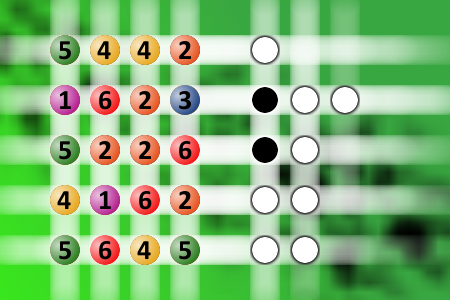
Which is a winning combination of digits?
[7065] Which is a winning combination of digits? - The computer chose a secret code (sequence of 4 digits from 1 to 6). Your goal is to find that code. Black circles indicate the number of hits on the right spot. White circles indicate the number of hits on the wrong spot. - #brainteasers #mastermind - Correct Answers: 15 - The first user who solved this task is Nasrin 24 T
BRAIN TEASERS
enter your answer and press button OK

Which is a winning combination of digits?

The computer chose a secret code (sequence of 4 digits from 1 to 6). Your goal is to find that code. Black circles indicate the number of hits on the right spot. White circles indicate the number of hits on the wrong spot.
Correct answers: 15
The first user who solved this task is Nasrin 24 T.
#brainteasers #mastermind
Register with your Google Account and start collecting points.
Check your ranking on list.

Fixing Broken Computers

An office technician got a call from a user. The user told the tech that her computer was not working. She described the problem and the tech concluded that the computer needed to be brought in and serviced.
He told her to "Unplug the power cord and bring it up here and I will fix it."
About fifteen minutes later she shows up at his door with the power cord in her hand.
Jokes of the day - Daily updated jokes. New jokes every day.
Follow Brain Teasers on social networks

Brain Teasers

puzzles, riddles, mathematical problems, mastermind, cinemania...

Henry Faulds

Died 19 Mar 1930 at age 86 (born 1 Jun 1843).Scottish physician who, from 1873, became a missionary in Japan, where he worked as a surgeon superintendent at a Tokyo hospital, taught at the local univeristy, and founded the Tokyo Institute for the Blind. In the late 1870s, his attention was drawn to fingerprints of ancient potters remaining on their work that he helped unearth at an archaeological dig site in Japan. He commenced a study of fingerprints, and became convinced that each individual had a unique pattern. He corresponded on the subject with Charles Darwin, and published a paper about his ideas in Nature (28 Oct 1880). When he returned to Britain in 1886, he unsuccessfully offered his fingerprinting identification scheme for forensic uses to Scotland Yard. Undeserved confusion on priority for the discovery with Francis Galton and Sir William J. Herschel lasted until 1917.«
This site uses cookies to store information on your computer. Some are essential to help the site properly. Others give us insight into how the site is used and help us to optimize the user experience. See our privacy policy.