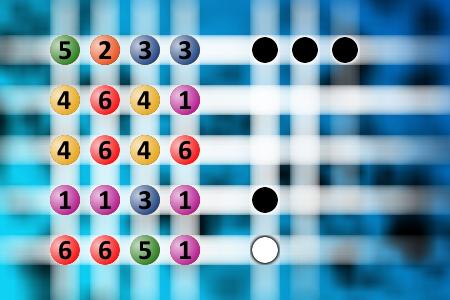
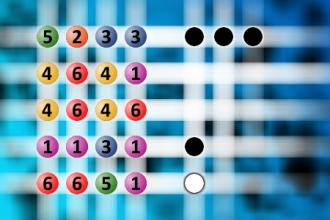
Which is a winning combination of digits?
[7243] Which is a winning combination of digits? - The computer chose a secret code (sequence of 4 digits from 1 to 6). Your goal is to find that code. Black circles indicate the number of hits on the right spot. White circles indicate the number of hits on the wrong spot. - #brainteasers #mastermind - Correct Answers: 10
BRAIN TEASERS
enter your answer and press button OK

Which is a winning combination of digits?

The computer chose a secret code (sequence of 4 digits from 1 to 6). Your goal is to find that code. Black circles indicate the number of hits on the right spot. White circles indicate the number of hits on the wrong spot.
Correct answers: 10
#brainteasers #mastermind
Register with your Google Account and start collecting points.
Check your ranking on list.

A woman walked up to a little...

A woman walked up to a little old man rocking in a chair on his porch. "I couldn't help noticing how happy you look," she said. "What's your secret for a long happy life?"
"I smoke three packs of cigarettes a day," he said. "I also drink a case of whiskey a week, eat fatty foods, and never exercise."
"That's amazing," said the woman, "how old are you?"
"Twenty-six," he said.
Jokes of the day - Daily updated jokes. New jokes every day.
Follow Brain Teasers on social networks

Brain Teasers

puzzles, riddles, mathematical problems, mastermind, cinemania...

Johann Georg Gmelin

Died 20 May 1755 at age 45 (born 10 Aug 1709).German explorer, natural scientist and botanist who acted as a natural historian on the imperial scientific expedition led by Friedrich Müller ineastern Siberia (1733-43). From barometric pressure readings, he was first to determine that the shores of the Caspian lay below sea level. In 1735, at the town of Yeniseysk, he recorded a record low temperature. He also detected the permafrost in eastern Siberia, which, a little way below the surface of the ground remained frozen year round. Gmelin spent the period 1747-69 preparing a book recording his finds there. InFlora sibirica sive historia plantorum Sibiriae, he detailed 1,178 species and provided 294 illustrations. His original degree was in medicine (1727), but his fields of study included chemistry, natural resources, geology, zoology, ethnography and geography. He was Leopold Gmelin's great uncle.«
This site uses cookies to store information on your computer. Some are essential to help the site properly. Others give us insight into how the site is used and help us to optimize the user experience. See our privacy policy.