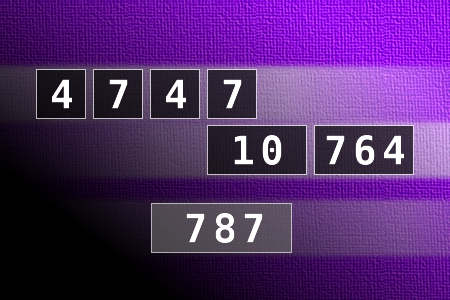
Calculate the number 787
[7242] Calculate the number 787 - NUMBERMANIA: Calculate the number 787 using numbers [4, 7, 4, 7, 10, 764] and basic arithmetic operations (+, -, *, /). Each of the numbers can be used only once. - #brainteasers #math #numbermania - Correct Answers: 3
BRAIN TEASERS
enter your answer and press button OK

Calculate the number 787

NUMBERMANIA: Calculate the number 787 using numbers [4, 7, 4, 7, 10, 764] and basic arithmetic operations (+, -, *, /). Each of the numbers can be used only once.
Correct answers: 3
#brainteasers #math #numbermania
Register with your Google Account and start collecting points.
Check your ranking on list.

A guy goes to the supermarket...

A guy goes to the supermarket and notices an attractive woman waving at him.
She says hello. He's rather taken a back because he can't place where he knows her. So he says, "Do you know me?"
To which she replies, "I think you're the father of one of my kids."
Now his mind travels back to the only time he has ever been unfaithful to his wife, and he says, "Oh, are you the stripper from my bachelor party that I did on the pool table with all my buddies watching while your partner whipped me with wet celery?"
The woman looks sternly into his eyes and says very calmly, "No, I'm your son's teacher."
Jokes of the day - Daily updated jokes. New jokes every day.
Follow Brain Teasers on social networks

Brain Teasers

puzzles, riddles, mathematical problems, mastermind, cinemania...

Sir Joseph Norman Lockyer

Died 16 Aug 1920 at age 84 (born 17 May 1836). English astronomer who in 1868 discovered and named the element helium that he found in the Sun's atmosphere before it had been detected on Earth. He also applied the name chromosphere for the sun's outer layer. Lockyer discovered, together with Pierre J. Janssen, the prominences (red flames) that surround the solar disk. He was also interested in the classification of stellar spectra and developed the meteoric hypothesis of stellar evolution. His works include the books Contributions to Solar Physics (1873), The Sun's Place in Nature (1897) and Inorganic Evolution (1900).
This site uses cookies to store information on your computer. Some are essential to help the site properly. Others give us insight into how the site is used and help us to optimize the user experience. See our privacy policy.