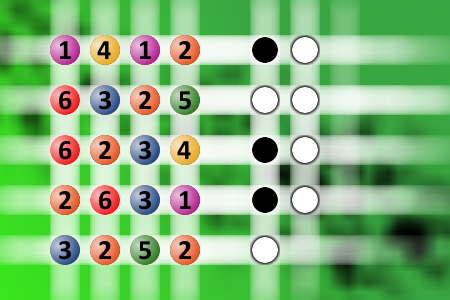
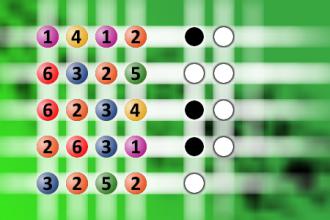
Which is a winning combination of digits?
[7578] Which is a winning combination of digits? - The computer chose a secret code (sequence of 4 digits from 1 to 6). Your goal is to find that code. Black circles indicate the number of hits on the right spot. White circles indicate the number of hits on the wrong spot. - #brainteasers #mastermind - Correct Answers: 5
BRAIN TEASERS
enter your answer and press button OK

Which is a winning combination of digits?

The computer chose a secret code (sequence of 4 digits from 1 to 6). Your goal is to find that code. Black circles indicate the number of hits on the right spot. White circles indicate the number of hits on the wrong spot.
Correct answers: 5
#brainteasers #mastermind
Register with your Google Account and start collecting points.
Check your ranking on list.

Moths

A woman was having a passionate affair with an inspector from pest-control company. One afternoon they were carrying on in the bedroom together when her husband arrived home unexpectedly. "Quick," said the woman to her lover, "into the closet!", and she pushed him into the closet stark naked. The husband, however, became suspicious and after a search of the bedroom discovered the man in the closet. "Who are you?" he asked him.
"I'm an inspector from Bugs-B-Gone," said the exterminator.
What are you doing in there?" the husband asked.
I'm investigating a complaint about an infestation of moths," the man replied.
"And where are your clothes?" asked the husband.
The man looked down at himself and said, "Those little bastards!"

Jokes of the day - Daily updated jokes. New jokes every day.
Follow Brain Teasers on social networks

Brain Teasers

puzzles, riddles, mathematical problems, mastermind, cinemania...

Ilya Prigogine

Born 25 Jan 1917; died 28 May 2003 at age 86. Russian-born Belgian physical chemist who received the Nobel Prize for Chemistry in 1977 for contributions to nonequilibrium thermodynamics, or how life could continue indefinitely in apparent defiance of the classical laws of physics. The main theme of Prigogine's work was the search for a better understanding of the role of time in the physical sciences and in biology. He attempted to reconcile a tendency in nature for disorder to increase (for statues to crumble or ice cubes to melt, as described in the second law of thermodynamics) with so-called "self-organisation", a countervailing tendency to create order from disorder (as seen in, for example, the formation of the complex proteins in a living creature from a mixture of simple molecules).
This site uses cookies to store information on your computer. Some are essential to help the site properly. Others give us insight into how the site is used and help us to optimize the user experience. See our privacy policy.